 listicle
7 Ways to Minimize Taxes on Social Security
Table of Contents
- 1. Manage Your Combined Income to Stay Below Tax Thresholds
- 2. Convert Traditional IRAs to Roth IRAs Before Claiming Benefits
- 3. Use Qualified Charitable Distributions to Reduce Taxable Income
- 4. Strategically Harvest Tax Losses in Your Investment Portfolio
- 5. Delay Social Security Benefits to Reduce Tax Impact Over Time
- 6. Understand Which States Tax Social Security Benefits
- 7. Coordinate Withdrawals from Tax-Deferred and Tax-Free Accounts
- Conclusion
Last Updated: August 16, 2026
1. Manage Your Combined Income to Stay Below Tax Thresholds
Your combined income, adjusted gross income plus tax-exempt interest plus half your Social Security benefits, determines whether your benefits get taxed. For single filers, benefits remain tax-free if combined income stays below $25,000. For married couples filing jointly, the threshold is $32,000. Above those amounts, up to 50% of benefits become taxable. Cross $34,000 as a single filer or $44,000 as a married couple, and up to 85% of benefits face taxation.
A single additional dollar of income can push you into a higher taxation bracket. Many retirees don't realize that seemingly small income sources, a consulting gig, dividend distributions, or tax-exempt interest, count toward this calculation.

The strategy is deliberate income management. If you're close to a threshold, defer a bonus, time asset sales, or adjust when you claim other income sources. Working with a financial advisor like those at Tax-Free Me helps you model these scenarios before the tax year begins, showing exactly how a $5,000 consulting project affects your combined income calculation and what portion of your benefits would become taxable.
State taxes complicate this further. Some states don't tax Social Security benefits at all, while others apply their own rules on top of federal taxation.
2. Convert Traditional IRAs to Roth IRAs Before Claiming Benefits
A Roth conversion moves money from a tax-deferred account into a Roth IRA, where it grows tax-free and withdrawals in retirement are tax-free. You pay income tax on the converted amount in the year of conversion, but once the money sits in the Roth, it no longer counts toward your combined income calculation when you start taking Social Security. Over 20 or 30 years of retirement, this can save substantially on the taxation of your benefits.
The ideal window for conversions is the years between retirement and when you claim benefits. Many people retire at 62 but delay Social Security until 67 or 70. Those intervening years, when you have little earned income, are perfect conversion years with lower tax brackets and no Social Security benefits inflating your combined income.
Tax-Free Me specializes in modeling Roth conversion strategies tailored to your specific situation, analyzing your traditional IRA balance, expected Social Security claim age, and tax bracket to determine the optimal conversion amount each year. This multi-year strategy accounts for how conversions affect Medicare premiums, state taxes, and the ultimate taxation of your benefits.
3. Use Qualified Charitable Distributions to Reduce Taxable Income
A qualified charitable distribution (QCD) allows you to transfer money directly from your IRA to a qualified charity once you reach age 70½. The distribution counts toward your required minimum distribution (RMD) but doesn't count as taxable income. The annual limit for QCDs is $111,000 per individual for 2026.
If you're 72, claiming Social Security, and facing a $50,000 RMD from your traditional IRA, a $50,000 QCD to your favorite charity satisfies your RMD while keeping your AGI $50,000 lower, directly improving your combined income calculation and reducing Social Security taxation.
You can only make QCDs to qualified charities, not to donor-advised funds, private foundations, or supporting organizations. Work with your IRA custodian to ensure the distribution goes directly to the charity. QCDs are one of the most underutilized levers for reducing combined income.
4. Strategically Harvest Tax Losses in Your Investment Portfolio
Tax-loss harvesting is selling an investment at a loss to offset capital gains elsewhere in your portfolio or to reduce your overall taxable income. You sell a mutual fund down 15% from purchase, then immediately buy a similar (but not "substantially identical") fund to maintain market exposure. The realized loss offsets capital gains or up to $3,000 of ordinary income in that tax year.
If you're approaching a combined income threshold, accelerate harvesting in that year to reduce your AGI. In years where you're well below the threshold, defer harvesting to preserve losses for future years when they're more valuable.
The IRS has a "wash-sale rule" that disallows losses if you buy a substantially identical security within 30 days before or after the sale. For investors with sizable non-retirement portfolios, working with an advisor who actively monitors tax-loss opportunities throughout the year can save thousands in combined income-related taxation over your retirement.
5. Delay Social Security Benefits to Reduce Tax Impact Over Time
Delaying from age 62 to age 70 increases your benefit by roughly 76% (8% per year between full retirement age and 70). When you delay claiming, you reduce your combined income in the years before you claim. Those early retirement years are perfect for executing Roth conversions, harvesting tax losses, or making QCDs without Social Security benefits inflating your combined income.
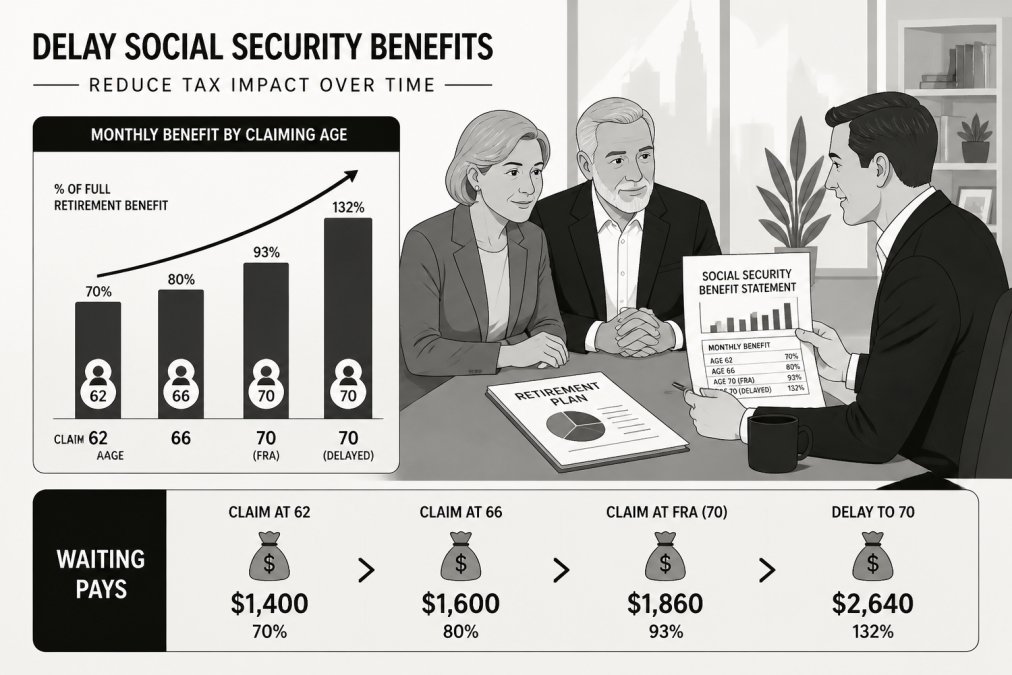
If you delay claiming and use those intervening years to execute Roth conversions, you're moving money into a tax-free vehicle while your tax bracket is lower. Over 20 years of retirement, this sequencing can save tens of thousands in total taxes.
This strategy isn't right for everyone. If you have health concerns or limited life expectancy, claiming earlier makes sense. But for people in average or above-average health, the combination of a higher monthly benefit plus the tax-efficiency of delaying is compelling.
Tax-Free Me works with clients to model the break-even point for their specific situation, analyzing your health, family longevity history, other income sources, and tax bracket to determine whether delaying to 67, 70, or somewhere in between makes sense.
6. Understand Which States Tax Social Security Benefits
Most states don't tax Social Security benefits, but some do. Thirteen states currently tax Social Security benefits to some degree: Colorado, Connecticut, Kansas, Minnesota, Missouri, Montana, Nebraska, New Mexico, Rhode Island, Utah, Vermont, and West Virginia. Each state has different rules, with some taxing benefits above a certain income threshold, others taxing all benefits, and some offering exemptions for certain age groups or income levels.
If you're in a state that taxes Social Security, the calculation is typically separate from the federal taxation formula. You might owe federal tax on 85% of your benefits but state tax on a different percentage.
For residents of Upstate South Carolina, you don't face state taxation on Social Security benefits, which simplifies your tax planning and leaves more of your benefit in your pocket. Understanding your destination state's rules is essential if you're considering a move.
7. Coordinate Withdrawals from Tax-Deferred and Tax-Free Accounts
Your withdrawal sequencing in retirement determines how much of your Social Security gets taxed. If you withdraw heavily from tax-deferred accounts like traditional IRAs and 401(k)s early in retirement, you inflate your combined income in those years, increasing the taxation of your benefits. Strategic coordination can minimize your combined income in years when you're claiming Social Security.
The ideal sequencing typically looks like this: In early retirement, before claiming Social Security, draw primarily from Roth IRAs (tax-free) and after-tax brokerage accounts (where you only pay tax on gains). Defer withdrawals from tax-deferred accounts. Once you claim Social Security, you're already committed to a higher combined income, so the tax-efficiency of your withdrawal source matters less.
Health Savings Accounts (HSAs) add another layer. After age 65, you can withdraw from an HSA for any reason (though non-medical withdrawals are taxed as ordinary income). If you use the HSA for qualified medical expenses, the withdrawal is entirely tax-free. Coordinating HSA withdrawals with your other account withdrawals can further optimize your combined income.
Tax-Free Me creates a multi-year withdrawal plan that coordinates distributions from all your accounts, traditional IRAs, Roth IRAs, 401(k)s, HSAs, and taxable brokerage accounts, to minimize your combined income in the years you're claiming Social Security and beyond.
| Strategy | Impact on Combined Income | Best Timing | Key Consideration |
|---|---|---|---|
| Managing combined income | Direct reduction | Before claiming Social Security | Requires precise income timing |
| Roth conversions | Increases current year, reduces future years | Before claiming Social Security | Tax bracket management is critical |
| Qualified charitable distributions | Direct reduction | Age 70½ or older | Limited to charitable giving |
| Tax-loss harvesting | Reduces AGI directly | Throughout retirement | Requires active portfolio management |
| Delaying Social Security | Reduces combined income in early years | Before age 70 | Improves lifetime benefit amount |
| State tax awareness | Varies by state | Ongoing | South Carolina has no state tax on benefits |
| Withdrawal sequencing | Reduces combined income strategically | Ongoing | Requires multi-year planning |
Minimizing taxes on Social Security benefits isn't about a single move, it's a coordinated strategy that spans years and multiple account types. The difference between a reactive approach and a proactive one can easily exceed $50,000 or more over your retirement.
Tax-Free Me specializes in comprehensive retirement tax planning, working with clients to model different scenarios, identify tax-efficient withdrawal sequences, and execute strategies like Roth conversions and QCDs at the right time. The firm's 25 years of experience from financial advisor R. Neal Angel means you're working with someone who has navigated these strategies through multiple market cycles and tax law changes. Get started with Tax-Free Me and develop a personalized Social Security and tax optimization plan tailored to your specific situation.
Frequently Asked Questions
At what income level do Social Security benefits become taxable?
Social Security benefits become taxable when your combined income exceeds certain thresholds. For single filers, benefits begin to be taxed if combined income exceeds $25,000; for married couples filing jointly, the threshold is $32,000. Combined income includes your adjusted gross income, tax-exempt interest, and half of your Social Security benefits. Understanding how to calculate combined income for social security is essential for tax planning. Even modest income from part-time work or investment earnings can push you over these thresholds, making strategic withdrawal planning critical.
How can a Roth conversion help reduce taxes on my Social Security benefits?
Converting funds from a traditional IRA to a Roth IRA removes future required minimum distributions from your taxable income calculation. Since required minimum distributions increase your combined income, eliminating them through Roth conversions can keep you below the tax thresholds that trigger Social Security taxation. This strategy works best when executed several years before you claim benefits, allowing time for the converted amounts to grow tax-free. However, the conversion itself creates a one-time tax bill, so timing and amount matter significantly.
What are qualified charitable distributions and how do they reduce Social Security taxes?
Qualified charitable distributions allow individuals age 70½ or older to transfer up to $111,000 annually directly from an IRA to a qualified charity. The distributed amount is excluded from your taxable income, which lowers your combined income and reduces the percentage of Social Security benefits subject to taxation. QCDs are particularly effective for those who itemize charitable giving but take the standard deduction, since the distribution doesn't increase your adjusted gross income. This strategy satisfies required minimum distributions without triggering additional tax liability.
Do I need to worry about state taxes on Social Security benefits?
Most states do not tax Social Security benefits, but a few states that tax social security benefits include Colorado, Connecticut, Kansas, Minnesota, Missouri, Montana, Nebraska, New Mexico, Rhode Island, Utah, and Vermont. If you live in one of these states, your combined state and federal tax burden on benefits can be significantly higher. Understanding your specific state's rules is essential for complete retirement tax planning. Moving to a state that doesn't tax Social Security is a legitimate strategy for some retirees, though other factors should also be considered.
How does working part-time in early retirement affect my Social Security taxes?
Part-time income increases your adjusted gross income, which raises your combined income and can push more of your Social Security benefits into taxable territory. Even modest earnings from consulting or part-time employment count toward the income thresholds. If you're considering working between age 62 and your full retirement age, coordinate that income with your Social Security claiming decision. Delaying benefits while working part-time can be more tax-efficient than claiming early and working simultaneously, since delayed benefits have a higher tax-free portion.
This article was written using GrandRanker