 how-to
How to Lower Medicare IRMAA Premiums: A Strategic Guide
Table of Contents
- What Is IRMAA and Why It Affects Your Medicare Costs
- Understanding Modified Adjusted Gross Income (MAGI) and Income Thresholds
- Medicare Life-Changing Event Examples That Qualify for Premium Reduction
- Tax-Smart Strategies to Reduce Your MAGI and Lower IRMAA Premiums
- How to File Form SSA-44 Instructions for an IRMAA Appeal
- The Two-Year Lookback Rule and How It Affects Your Premiums
- Common Mistakes to Avoid When Planning for IRMAA
- Conclusion
Last Updated: August 7, 2026
What Is IRMAA and Why It Affects Your Medicare Costs
Income-Related Monthly Adjustment Amount (IRMAA) is a surcharge added to your Medicare Part B and Part D premiums when your income exceeds certain thresholds. The surcharge structure is progressive: the higher your Modified Adjusted Gross Income (MAGI), the steeper your premium adjustment. For some retirees, these additional costs add thousands of dollars annually to their Medicare expenses.
The key insight is this: your Medicare premiums are based on your tax return from two years prior. That two-year lookback period creates an opportunity window. By understanding which income sources count toward MAGI and which don't, you can structure your retirement withdrawals to minimize premium surcharges while maintaining the income you need.
Understanding Modified Adjusted Gross Income (MAGI) and Income Thresholds
Your MAGI determines whether you pay standard Medicare premiums or face surcharges. For IRMAA purposes, your MAGI includes wages, interest, dividends, capital gains, and distributions from tax-deferred retirement accounts. However, certain income sources don't count: Roth conversion proceeds themselves don't increase your MAGI in the year of conversion, and qualified charitable distributions bypass your MAGI calculation entirely.
This distinction is critical. Two retirees with identical total income can face vastly different IRMAA surcharges depending on which accounts they draw from. The income thresholds create what's called the "IRMAA cliff effect." If your MAGI is one dollar below the threshold, you pay standard premiums. One dollar above, and you move into the next surcharge bracket. This creates a powerful incentive to structure your income strategically rather than randomly withdrawing from whichever account is most convenient.
Medicare Life-Changing Event Examples That Qualify for Premium Reduction
Life-changing events can trigger an IRMAA reduction without waiting for the two-year lookback period to reset. The Social Security Administration recognizes specific circumstances where your income has materially changed, including marriage, divorce, death of a spouse, loss of income-producing property, loss of pension, or significant income reduction.
Common scenarios include retirement mid-year (if your lookback year shows full employment income) or the death of a spouse (if you were married filing jointly in the lookback year but are now single). Work reduction or job loss also qualifies if you were earning supplemental income in the lookback year but have since retired.
The appeal process requires documentation of the life-changing event. File Form SSA-44 (Request for Review of an Earnings Suspicion) and provide evidence: a death certificate, divorce decree, retirement statement, or other official documentation showing when your circumstances changed.
Tax-Smart Strategies to Reduce Your MAGI and Lower IRMAA Premiums
The most effective approach to lowering Medicare IRMAA premiums is proactive income management. Rather than reacting to surcharges after the fact, you structure your retirement withdrawals to keep your MAGI below the threshold that triggers surcharges.

The first strategy is withdrawal sequencing. Instead of taking distributions proportionally from all your accounts, prioritize accounts that don't count toward MAGI. If you have after-tax savings or taxable brokerage accounts, draw from these first. Your MAGI stays lower while you still access the retirement income you need.
Many retirees also delay Social Security claiming to reduce current-year income. Delaying Social Security by even one or two years can lower your MAGI significantly during those years, potentially keeping you below the IRMAA threshold. The timing of capital gains realization also matters: spreading capital gains across multiple years rather than realizing them all at once keeps any single year's MAGI lower.
Roth Conversions and Their IRMAA Impact
A Roth conversion moves funds from a traditional tax-deferred account into a Roth account. In the year of conversion, you pay income tax on the amount converted, which increases your MAGI and potentially triggers IRMAA surcharges. However, future withdrawals from the Roth account don't count toward MAGI.
This creates a strategic trade-off. You might accept a higher MAGI (and higher Medicare premiums) in the conversion year to build a pool of tax-free income that won't trigger surcharges in later years. The timing is crucial: if you're in a year where your MAGI is already high, a conversion might push you into a surcharge bracket you'd otherwise avoid. But if you're in a lower-income year, a conversion might keep you below the threshold while building tax-free retirement income.
Qualified Charitable Distributions (QCDs)
A qualified charitable distribution allows you to transfer funds directly from your IRA to a qualified charity. The distribution doesn't count as income on your tax return, which means it doesn't increase your MAGI. This is the most tax-efficient way to give to charity if you're over 73 years old.
For retirees who are charitably inclined, QCDs can be the difference between staying below the IRMAA threshold and triggering surcharges. Your IRA custodian transfers the funds directly to the charity. You don't receive the distribution yourself; it goes straight from your IRA to the charitable organization. This direct transfer is what prevents the QCD from counting as income.
Managing Required Minimum Distributions (RMDs)
Required Minimum Distributions are mandatory withdrawals from tax-deferred retirement accounts starting at age 73. These withdrawals count fully toward your MAGI, and for many retirees, RMDs are the largest single source of IRMAA-triggering income.
The challenge is that RMDs are calculated based on your account balance and life expectancy tables. You don't have flexibility in the amount you must withdraw, but you do have flexibility in how you handle that distribution. If you don't need the RMD for living expenses, a qualified charitable distribution is the solution. Another approach involves Roth conversions of IRA funds before you reach the RMD age, which reduces the balance that RMDs are calculated on and lowers your mandatory distributions in later years.
How to File Form SSA-44 Instructions for an IRMAA Appeal
Form SSA-44 (Request for Review of an Earnings Suspicion) is the official document you file with the Social Security Administration to appeal an IRMAA determination when your circumstances have changed since the tax year used to calculate your current premiums.
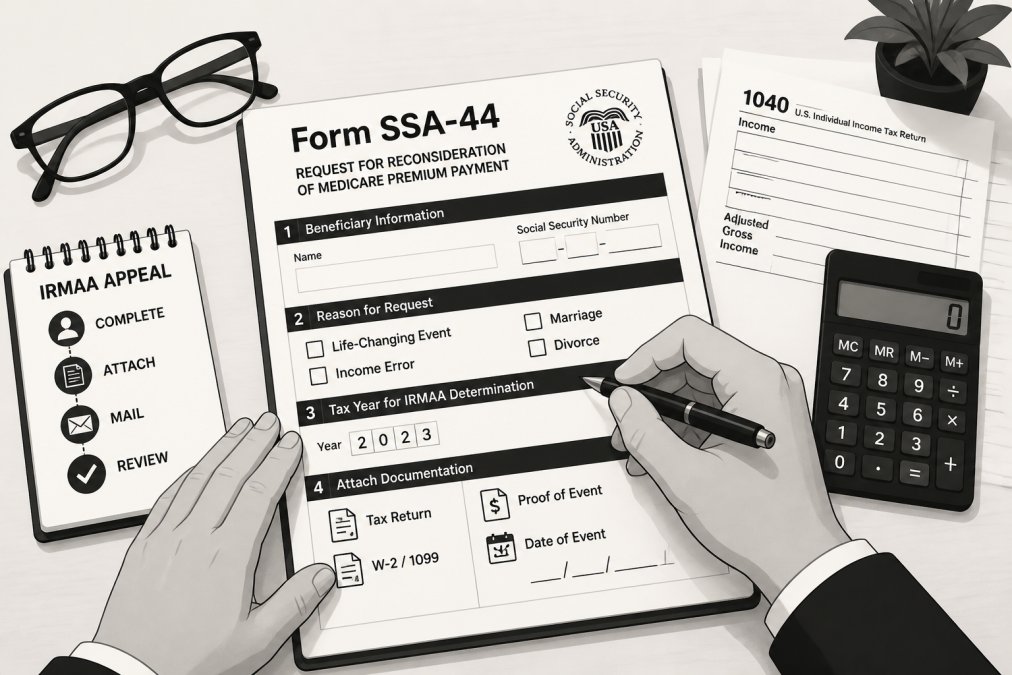
The form asks for specific information: your name, Social Security number, the year your IRMAA determination was based on, the type of life-changing event, and the date it occurred. You'll also describe how your income has changed as a result.
Supporting documentation is critical. Don't just write "I retired." Provide your final pay stub, a letter from your employer confirming your retirement date, or a copy of your retirement application. If you're appealing based on a spouse's death, include the death certificate. If you've had a significant reduction in income from investments, provide statements showing the change.
You can file Form SSA-44 online through your Social Security account, by mail, or in person at your local Social Security office. The Social Security Administration typically responds within 30 days. If your appeal is approved, your IRMAA surcharge is adjusted retroactively to the month after your life-changing event occurred.
The Two-Year Lookback Rule and How It Affects Your Premiums
Your Medicare premiums for any given year are based on your tax return from two years prior. In 2026, your Medicare Part B and Part D premiums are based on your 2024 tax return. Your 2025 tax return won't affect your premiums until 2027. This creates a planning window: you can adjust your 2026 income strategy knowing exactly what your 2024 MAGI was.
This lookback period is why life-changing events matter so much. If you retired in 2025, your 2024 tax return still shows employment income. You'll face IRMAA surcharges in 2026 and 2027 based on that historical income. But you can appeal based on the life-changing event of retirement, and your surcharge can be adjusted.
Strategic retirees use this knowledge to plan ahead. If you know you'll have a high-income year, you can prepare for the IRMAA consequences two years out. Conversely, if you're in a low-income year, you know that surcharges won't hit you for two more years, giving you time to adjust your strategy.
Common Mistakes to Avoid When Planning for IRMAA
The first mistake is ignoring IRMAA in retirement planning. Many retirees focus on income taxes and overlook the Medicare premium surcharges. They withdraw funds without considering the IRMAA impact, and suddenly they're paying thousands more in premiums than anticipated.
The second mistake is making large, unplanned withdrawals without understanding the MAGI consequences. A better approach would be to use savings, a home equity line of credit, or to plan the withdrawal in a year when it wouldn't cross an IRMAA threshold.
A third mistake is not understanding which income sources count toward MAGI. Knowing these distinctions allows you to structure withdrawals strategically. Many retirees also fail to coordinate their Social Security claiming age with their IRMAA strategy. The optimal claiming age depends not just on longevity but on how it interacts with IRMAA thresholds.
Another common mistake is not filing an appeal when circumstances change. Retirees receive their IRMAA notice and assume it's permanent, not realizing they can appeal if they've experienced a life-changing event. Finally, many retirees don't plan their Roth conversions with IRMAA in mind. A conversion might make sense from a tax perspective, but if it pushes you into a higher IRMAA surcharge bracket, the Medicare premium increase might offset the tax savings.
Conclusion
How to lower Medicare IRMAA premiums requires understanding the mechanics of the two-year lookback rule, identifying which income sources trigger surcharges, and strategically managing your retirement withdrawals. The difference between reactive retirees and strategic ones is measured in thousands of dollars across retirement.
Tax-Free Me specializes in exactly this kind of planning. With 25 years of financial advisory experience, R. Neal Angel and the team at Tax-Free Me help clients in Upstate South Carolina implement Roth conversions, optimize Social Security claiming, and structure their retirement income to minimize IRMAA surcharges while securing their long-term financial security. If you're approaching retirement or already retired and facing unexpected Medicare premium increases, get started with a consultation to understand your specific situation and the tax-advantaged strategies available to you.
Frequently Asked Questions
What qualifies as a life-changing event for IRMAA reduction?
Life-changing events that allow you to file Form SSA-44 for an IRMAA reduction include marriage, divorce, death of a spouse, loss of income-producing property, loss of a pension, or a significant decrease in income. The Social Security Administration evaluates whether your current income is a more accurate reflection of your expected future income than the tax return used to calculate your IRMAA. You must file within 60 days of the event to request a reduction.
How does a Roth conversion affect my Medicare IRMAA premiums?
A Roth conversion increases your Modified Adjusted Gross Income (MAGI) in the year you convert, which can raise your IRMAA surcharges. However, because of the two-year lookback rule, the higher income from the conversion affects your premiums for two years following the conversion year. After that period, future Roth distributions are tax-free and do not count toward MAGI, potentially lowering your premiums long-term. Work with a financial advisor to time conversions strategically.
Can I appeal an IRMAA determination if my income has decreased?
Yes, you can appeal an initial IRMAA determination by filing Form SSA-44 if you experience a life-changing event or if your current income is significantly lower than the tax return used to calculate your premium adjustment. The Social Security Administration will review your appeal and may reduce or eliminate your surcharges if your expected future income is lower. The appeals process typically takes several weeks; contact Social Security directly for status updates.
What is the two-year lookback rule and how does it work?
Medicare uses your Modified Adjusted Gross Income from your federal tax return from two years prior to determine your IRMAA surcharges. For example, your 2026 Medicare premiums are based on your 2024 tax return income. This lookback period means that major income events (like Roth conversions or Required Minimum Distributions) affect your premiums for two years. Understanding this timing is critical for tax-smart retirement planning, especially when coordinating large financial decisions.
This article was written using GrandRanker