 how-to
How to Sequence Retirement Account Withdrawals
Table of Contents
- Why Withdrawal Sequencing Matters for Your Retirement
- The Tax-Efficient Retirement Withdrawal Strategy Framework
- Understanding the 4% Rule and Safe Withdrawal Rates
- Roth Conversion Timing and Tax Bracket Management
- Managing the Impact of RMDs on Retirement Income
- Tax-Efficient Withdrawal Sequencing in Practice
- Common Withdrawal Sequencing Mistakes to Avoid
- Conclusion
Last Updated: August 17, 2026
Why Withdrawal Sequencing Matters for Your Retirement
The order in which you withdraw from different accounts can mean the difference between running out of money at 85 or having a comfortable cushion at 95. Sequence retirement account withdrawals in the wrong order and you'll pay thousands more in taxes than necessary over your lifetime. According to research from the National Institute on Retirement Security, improper withdrawal sequencing can reduce portfolio longevity by several years.
Every dollar you withdraw carries different tax consequences. Money from a taxable account might trigger capital gains tax. Money from a traditional IRA counts as ordinary income. Money from a Roth IRA comes out tax-free. Understanding these distinctions and executing them strategically is what separates retirees who feel financially secure from those who constantly worry about running out.
The Tax-Efficient Retirement Withdrawal Strategy Framework
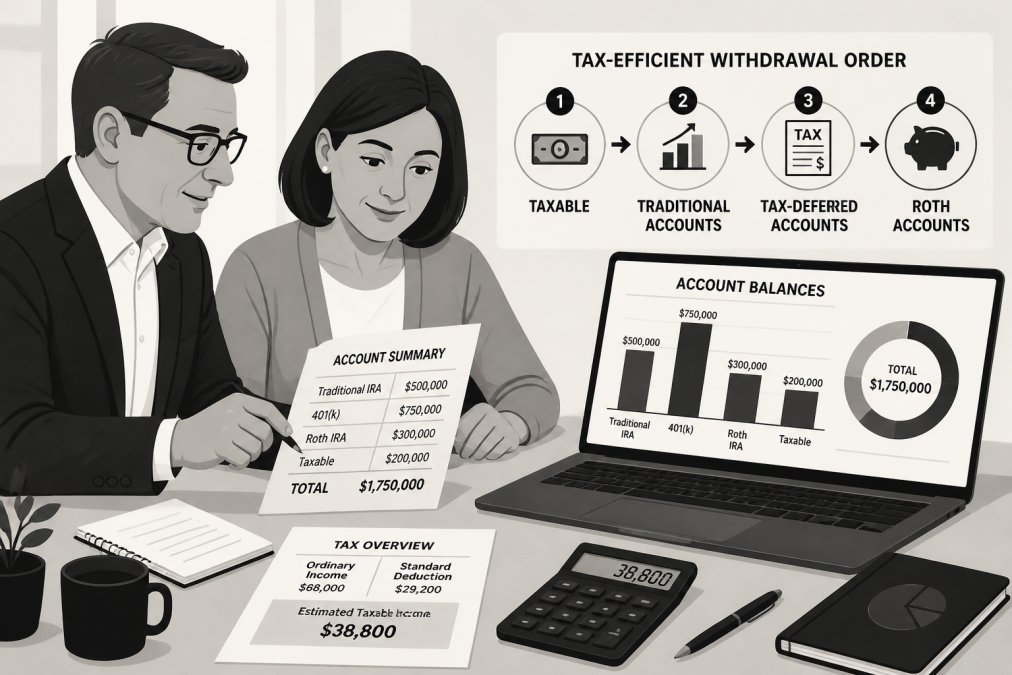
A tax-efficient retirement withdrawal strategy starts with a clear hierarchy: which accounts to tap first, second, and third. The conventional wisdom says to withdraw from taxable accounts first, then tax-deferred accounts, then tax-free accounts last. The optimal sequence depends on your specific situation: your tax bracket, your income sources, your heirs' situations, and the size of your various account balances.
Taxable Accounts First
Taxable brokerage accounts should generally be your first withdrawal source during retirement. When you withdraw, you'll owe taxes on any gains, but you have control over the timing and can manage your tax burden strategically. Your basis, the original amount you invested, can be withdrawn without any tax consequences. Only the gains trigger capital gains tax, and you can often choose which shares to sell (specific lot identification) to minimize those gains.
A common mistake is selling shares with the largest gains first. Instead, consider selling shares with the smallest gains or losses. You might even harvest tax losses strategically to offset gains elsewhere. Managing your taxable account withdrawals thoughtfully can reduce your lifetime tax bill by tens of thousands of dollars.
Tax-Deferred Accounts Second
Tax-deferred accounts, traditional IRAs, 401(k)s, 403(b)s, and similar vehicles, should typically be your second withdrawal source. Money in these accounts grew without any annual tax drag. But when you withdraw, every dollar counts as ordinary income in the year you take it out.
The challenge is that they force a choice: withdraw strategically now, or face Required Minimum Distributions (RMDs) later that might push you into higher tax brackets. Tax-deferred accounts also interact with Social Security taxation and Medicare premiums. A large withdrawal from a traditional IRA can push your modified adjusted gross income (MAGI) higher, which affects your Medicare Part B and Part D premiums.
Tax-Free Accounts Last
Roth IRAs and other tax-free accounts should typically be your last resort for withdrawals. Once money is in a Roth, it grows tax-free and comes out tax-free in retirement. The power of leaving tax-free accounts untouched as long as possible is that they continue compounding without any tax drag. A Roth IRA with 20 years left until your death can generate substantial tax-free growth.
Understanding the 4% Rule and Safe Withdrawal Rates
The 4% rule states that if you withdraw 4% of your portfolio in your first retirement year, then adjust that dollar amount for inflation each subsequent year, you have a high probability of not running out of money over a 30-year retirement. This rule came from research examining historical market returns and assumes a balanced portfolio (typically 60% stocks, 40% bonds), regular rebalancing, and discipline to stick with the plan even when markets are down.
The actual safe withdrawal rate for your situation might be higher or lower than 4%. If you retire at 55 instead of 65, you need your portfolio to last 40 years instead of 30, which argues for a lower withdrawal rate. If you have a pension or substantial Social Security income, you can afford to withdraw more from your portfolio. Many financial advisors now consider a range rather than a single number: somewhere between 3.5% and 4.5% for most situations, adjusted for your personal circumstances.
Roth Conversion Timing and Tax Bracket Management
A Roth conversion is when you take money from a traditional IRA or 401(k) and move it to a Roth IRA, paying taxes on the conversion amount in that year. If you're in a low tax bracket early in retirement (before claiming Social Security, before RMDs), you can convert at favorable rates. That money then grows tax-free forever.
Timing is everything with Roth conversions. Convert too much in one year and you'll spike your tax bracket, potentially triggering higher Medicare premiums. Convert too little and you're missing an opportunity to use low-income years. The sweet spot is filling your current tax bracket without jumping to the next one.
Many retirees between ages 55 and 70 have a window where Roth conversions make sense. You've left work, so employment income is gone. You haven't claimed Social Security yet. You haven't hit RMD age (73 for most people). This gap is often the best time to convert strategically. With proper planning, conversions are one of the most tax-efficient moves available.
Managing the Impact of RMDs on Retirement Income
Required Minimum Distributions (RMDs) are mandatory withdrawals from tax-deferred retirement accounts starting at age 73. If you don't take your RMD, you face a 25% penalty on the amount you should have withdrawn (reduced to 10% for certain situations).
RMDs create a real problem for many retirees: they force you to withdraw money you don't need, creating a larger taxable income than you'd choose. This can push you into a higher tax bracket, increase your Medicare premiums, or trigger taxation of your Social Security benefits.
The solution is planning ahead. Years before you hit RMD age, you should be thinking about which accounts to draw from and how to minimize the RMD impact. If you have a large traditional IRA and a smaller Roth IRA, you might accelerate Roth conversions in your 60s to reduce the traditional IRA balance and thus reduce your future RMDs.
Another strategy is the qualified charitable distribution (QCD). If you're charitably inclined, you can direct RMD money directly to qualified charities. This counts toward your RMD requirement without increasing your taxable income. For someone in a high tax bracket who wants to give to charity anyway, this is one of the most tax-efficient moves available.
Tax-Efficient Withdrawal Sequencing in Practice
Understanding the theory is one thing. Executing it correctly year after year is another.

Step 1: Calculate Your Annual Withdrawal Need
Start with a clear number: how much money do you need this year? This should include all your living expenses, planned large purchases, gifts, or anything else you'll spend. Build a detailed budget including housing, food, utilities, healthcare, travel, insurance, and discretionary spending.
Also account for income from other sources. Social Security, pensions, rental income, or part-time work all reduce the amount you need to withdraw from your portfolio.
Step 2: Assess Your Current Tax Bracket
Before you withdraw a dollar, know your tax bracket. Calculate your modified adjusted gross income (MAGI) for the year, as this determines Medicare premiums, Social Security taxation, and various other tax consequences. A withdrawal that seems small might push you into a higher Medicare premium bracket, costing you thousands in premiums.
Consider the long-term capital gains tax rates as well. If you're in a low ordinary income tax bracket, you might be in the 0% long-term capital gains bracket, making stock sales essentially free from a federal tax perspective.
Step 3: Execute Withdrawals in Optimal Order
With your needs calculated and your tax bracket understood, execute withdrawals in this order:
-
Taxable account withdrawals first. Sell shares with the smallest gains or losses. Use specific lot identification to minimize gains.
-
Tax-deferred account withdrawals second. If you still need money after taxable accounts, withdraw from traditional IRAs or 401(k)s, keeping in mind the tax impact.
-
Tax-free account withdrawals last. Only tap Roth IRAs or other tax-free accounts if you've exhausted other sources.
This order assumes you're not facing RMDs yet. Once RMDs begin at age 73, you'll take your required distribution first, then supplement with additional withdrawals if needed.
Step 4: Monitor and Rebalance Annually
Withdrawal sequencing isn't a set-it-and-forget-it decision. Review your withdrawal strategy annually, ideally before the end of the year so you can still make adjustments. If markets have been strong and your portfolio is overweighted in stocks, you might harvest some gains at favorable tax rates. If markets have been weak, you might shift to withdrawing from bonds instead of stocks to avoid selling equities at low prices.
Common Withdrawal Sequencing Mistakes to Avoid
Mistake 1: Withdrawing from the wrong account. Many retirees take money from their Roth IRA when they need it, forgetting that tax-free growth is irreplaceable. A better approach is to take from taxable accounts first, preserving tax-free growth as long as possible.
Mistake 2: Ignoring the tax bracket impact. A withdrawal that seems modest might push you into a higher tax bracket, triggering Medicare premium increases or Social Security taxation.
Mistake 3: Not planning for RMDs. The time to plan is in your 50s and 60s, when you can use Roth conversions and other strategies to minimize the RMD impact.
Mistake 4: Selling appreciated assets in down markets. When markets are down, maintain a cash reserve (one to two years of expenses) so you can fund withdrawals from cash in down markets, letting stocks recover.
Mistake 5: Forgetting about state taxes. Some states have no income tax, while others tax retirement income heavily. If you're considering relocating in retirement, the tax implications are substantial.
Mistake 6: Not coordinating with Social Security timing. Your Social Security claiming age affects your overall tax picture. These decisions are interconnected.
Withdrawal sequencing is one of the most underrated aspects of retirement planning. The difference between a thoughtful withdrawal strategy and a reactive one can easily exceed $100,000 over a 30-year retirement.
Tax-Free Me specializes in building personalized withdrawal strategies that minimize taxes while meeting your income needs. With 25 years of experience from financial advisor R. Neal Angel, the firm has helped clients navigate Roth conversions, RMD planning, and Social Security optimization to maximize their after-tax retirement income. If you're approaching retirement or already retired, a professional review of your withdrawal strategy can identify opportunities you might be missing. Get started with Tax-Free Me and discover how much you could save through tax-efficient retirement planning.
Frequently Asked Questions
What is the most tax-efficient order to withdraw from retirement accounts?
The standard approach is to withdraw from taxable accounts first, then tax-deferred accounts (traditional IRAs and 401(k)s), and tax-free accounts (Roth IRAs) last. This sequence minimizes your lifetime tax liability by allowing tax-free and tax-deferred growth to compound longer. However, your specific situation, including your tax bracket, Social Security timing, and RMD obligations, may warrant adjustments to this framework.
How does Roth conversion timing affect my overall withdrawal strategy?
Roth conversion timing is critical because converting during low-income years (before Social Security begins, before RMDs start) can lock in lower tax rates permanently. Strategic conversions in early retirement can reduce future RMDs, lower Medicare premiums, and minimize the tax impact of Social Security. The key is coordinating conversions with your tax bracket and other income sources to avoid pushing yourself into a higher bracket.
Can poor withdrawal sequencing increase my Medicare premiums?
Yes. Medicare premiums are based on Modified Adjusted Gross Income (MAGI), which includes distributions from tax-deferred accounts. Withdrawing too much from traditional IRAs or 401(k)s in a single year can trigger higher Income-Related Monthly Adjustment Amounts (IRMAA), increasing your Part B and Part D premiums. Thoughtful sequencing, including strategic Roth conversions and careful RMD planning, helps control MAGI and avoid surprise surcharges.
How do Required Minimum Distributions (RMDs) impact my withdrawal strategy?
RMDs are mandatory withdrawals from tax-deferred accounts starting at age 73 (as of 2023). These forced distributions can push you into a higher tax bracket and increase Medicare premiums if not planned carefully. By sequencing withdrawals strategically before RMDs begin, including Roth conversions during lower-income years, you can reduce the size of future RMDs and maintain better control over your tax liability throughout retirement.
This article was written using GrandRanker