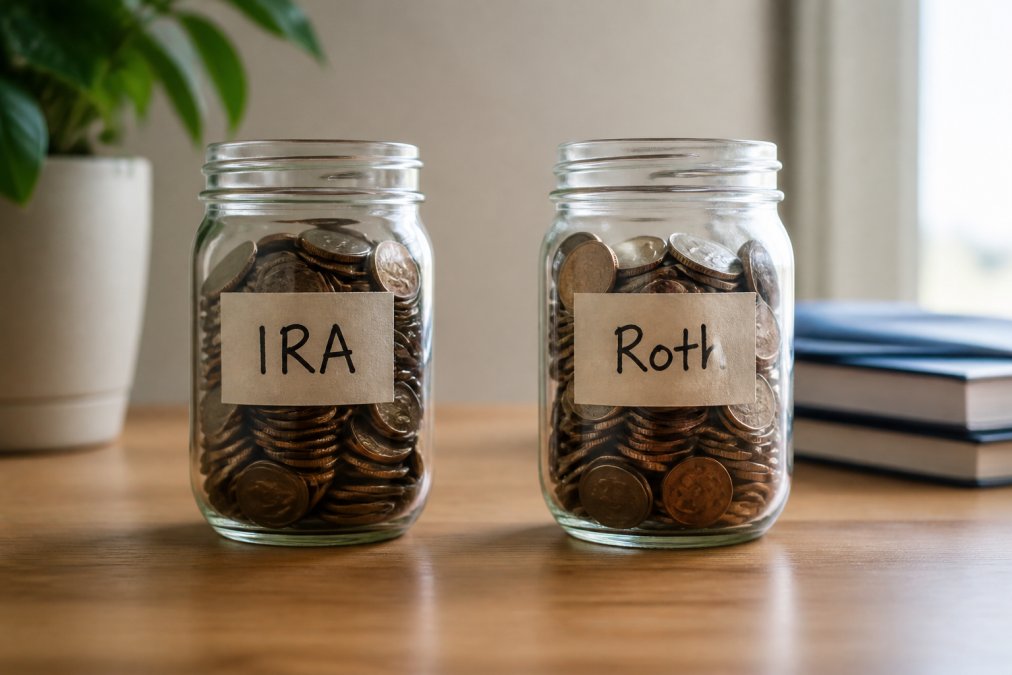
 comparison
IRA to Roth Conversion: Pros and Cons for 2026
Table of Contents
- What Is an IRA to Roth Conversion?
- Key Advantages of Converting to a Roth IRA
- Significant Drawbacks and Risks of Roth Conversions
- Understanding Roth Conversion Tax Implications
- When to Convert Traditional IRA to Roth: Timing Strategies
- The Roth Conversion Five-Year Rule Explained
- How to Execute a Roth Conversion
- Conclusion
Last Updated: August 9, 2026
What Is an IRA to Roth Conversion?
An IRA to Roth conversion is the process of moving funds from a traditional IRA, SEP IRA, or SIMPLE IRA into a Roth IRA. Unlike traditional IRAs, which hold pre-tax contributions and defer taxes until withdrawal, a Roth IRA accepts after-tax dollars and allows tax-free growth and tax-free distributions in retirement. When you convert, you pay taxes on the converted amount upfront, then enjoy tax-free growth forever.
The conversion itself is mechanically straightforward: you direct your financial institution to move money from your traditional account to your Roth account. The complexity lies in the tax math. You'll owe ordinary income tax on the full amount converted in the year you make the conversion, which can mean a significant tax bill for large balances.
The appeal is trading a known tax liability today for tax-free withdrawals later. If you believe tax rates will be higher in retirement or want to reduce required minimum distributions, a Roth conversion can be powerful. But it's a strategic decision entirely dependent on your personal situation, tax bracket, and retirement timeline.
At Tax-Free Me, we've spent 25 years helping clients evaluate whether an IRA to Roth conversion makes sense for their specific circumstances, accounting for everything from Medicare premium impacts to state tax considerations that most advisors overlook.
Key Advantages of Converting to a Roth IRA
The primary benefit is tax-free growth and tax-free withdrawals. Once your money is in a Roth, every dollar of growth compounds without tax drag. At withdrawal, you take the money out completely tax-free, assuming you meet the account age and holding-period requirements.
This creates tax diversification. Most people approaching retirement have bulk savings in tax-deferred accounts like traditional IRAs and 401(k)s. That concentration creates risk: required minimum distributions push your taxable income higher, triggering Medicare surcharges, reducing Social Security benefits, or pushing you into a higher tax bracket. A Roth conversion reduces this concentration risk by building a pool of tax-free income you can tap without cascading tax consequences.
For high-income earners, a Roth conversion solves an income-threshold problem. Roth IRAs have income limits preventing high earners from contributing directly, but there's no income limit on conversions. A high-income professional who can't contribute to a Roth directly can still access Roth benefits through a conversion strategy, sometimes called a backdoor Roth.
There's also an estate planning advantage. Roth IRAs aren't subject to required minimum distributions during your lifetime, allowing you to leave a larger, tax-free inheritance to heirs. When beneficiaries inherit a Roth IRA, they inherit tax-free income, a significant advantage over inheriting a traditional IRA.
Significant Drawbacks and Risks of Roth Conversions
The most obvious drawback is the immediate tax bill. Converting a large balance could mean owing tens of thousands of dollars in a single year. Many people fund the conversion from the IRA itself, converting less money while still owing the full tax bill. The smarter approach is paying the tax from outside funds, but that requires available cash.
There's also timing risk. If you convert and the market drops significantly, you've paid taxes on money now worth less. You can't undo the conversion to recapture that loss.
The five-year rule adds complexity. If you convert and withdraw those converted funds before five years have passed, you'll owe a 10% early-withdrawal penalty, even if you're over 59½. This rule applies separately to each conversion.
For people nearing Social Security eligibility, a conversion can backfire. Conversions count as taxable income, increasing your modified adjusted gross income and triggering Medicare premium surcharges under Income-Related Monthly Adjustment Amounts (IRMAA). A conversion saving $5,000 in taxes could cost $3,000 in Medicare premiums over a few years.
South Carolina taxes retirement income at your ordinary income tax rate. A large conversion could push you into a higher state tax bracket, adding another cost layer. Your state matters significantly.
Understanding Roth Conversion Tax Implications
When you execute an IRA to Roth conversion, you owe ordinary income tax on the converted amount in the year of conversion. The actual tax impact depends on several cascading factors.
First, consider your marginal tax bracket. Converting $100,000 in the 24% bracket means owing $24,000 in federal taxes, but the conversion pushes your income higher, potentially into the 32% bracket for the top portion.
Second, conversions trigger the pro-rata rule if you have other traditional IRAs. You can't cherry-pick only after-tax portions to convert; you must treat all traditional IRAs as a single pool. If you have a $500,000 traditional IRA and a $100,000 SEP IRA with only $50,000 after-tax, then a $100,000 conversion means roughly 83% is taxable.
The tax-free growth benefit only materializes with a long investment horizon. If you need the money in five years, the advantage is minimal. But with a 20 or 30-year horizon, tax-free compounding becomes substantial.

The backdoor Roth strategy is conversion-adjacent. If you've made non-deductible contributions to a traditional IRA, you can convert those after-tax contributions to a Roth with minimal tax impact. This is legal and effective, though the pro-rata rule still applies if you have other traditional IRAs.
When to Convert Traditional IRA to Roth: Timing Strategies
The best time to convert depends on your current tax bracket, expected retirement tax bracket, market conditions, and time horizon.
A conversion makes most sense when you're in a lower tax bracket than expected in retirement. If you're between jobs, taking a sabbatical, or in a year with unusually low income, that's a prime conversion window. You're paying taxes at a discount.
For working people, conversion often happens in the retirement year or immediately after. Once you stop working, your income and tax bracket drop, allowing favorable conversion rates.
Market timing matters too. Converting when your IRA balance is temporarily depressed, after a market correction, means converting fewer dollars at lower value. You'll owe less tax, and future tax-free growth will be on a lower base.

For South Carolina residents, consider the state tax angle. If you're planning to relocate to a no-income-tax state in retirement, converting before you move could be tax-inefficient. It's smarter to convert after relocating and establishing residency in a no-tax state.
Age matters too. If you're under 59½, a conversion opens a narrow window: you can access converted funds penalty-free after five years, even before 59½. This "conversion ladder" strategy is particularly useful for early retirees needing income before Social Security.
The Roth Conversion Five-Year Rule Explained
The five-year rule is one of the most misunderstood aspects of Roth conversions. There's actually more than one five-year rule, and they apply in different situations.
The conversion five-year rule says that if you convert funds and withdraw those converted funds within five years, you'll owe a 10% early-withdrawal penalty (if under 59½). Each conversion has its own separate five-year clock. A 2026 conversion has a five-year holding period through 2030; a 2027 conversion has its own window through 2031.
This means you can't convert and immediately withdraw without penalty. You need confidence you won't need that money for at least five years. Conversions suit people with a long time horizon and sufficient outside income.
The earnings five-year rule is different. It applies to growth on converted funds. If you convert $100,000 and it grows to $130,000, the $30,000 in earnings is subject to different holding periods. You can withdraw the original $100,000 penalty-free after five years, but the $30,000 in earnings requires you to be 59½ or meet another exception to avoid the 10% penalty.
For most people, this distinction doesn't matter because they're not planning early withdrawal. But for someone using the conversion ladder strategy for early retirement, understanding the earnings rule is critical.
| Rule | Applies To | Penalty If Withdrawn Early | Five-Year Clock Starts |
|---|---|---|---|
| Conversion Rule | Converted principal | 10% (if under 59½) | Year of conversion |
| Earnings Rule | Growth on conversions | 10% (if under 59½) | Year of conversion |
| Contribution Rule | Direct Roth contributions | None (always penalty-free) | N/A |
Each conversion year starts its own five-year clock. This is why conversion ladders, converting small amounts annually, require careful tracking.
How to Execute a Roth Conversion
The mechanical process is simple, but the planning should be rigorous.
Step 1: Decide on the conversion amount. Work backward from your target taxable income. If you're in the 22% bracket and want to stay there, calculate how much additional income you can take without spilling into the 24% bracket. That's your conversion sweet spot. Tax-Free Me specializes in this calculation, accounting for Social Security, Medicare, and state taxes.
Step 2: Confirm you have funds to pay the tax. The biggest mistake is converting and using IRA funds to pay the tax bill. If you convert $100,000 and owe $24,000, pay that from outside the IRA, savings, a taxable brokerage account, or current income. This preserves the full conversion benefit.
Step 3: Contact your financial institution. Most major custodians have straightforward conversion processes. You'll fill out a form requesting the conversion. Some allow online execution; others require a phone call or paper form.
Step 4: Specify direct or indirect conversion. A direct conversion moves funds straight from your traditional IRA to your Roth IRA without touching your hands. This is cleanest and avoids 60-day rollover complications. An indirect conversion sends you a check with 60 days to deposit it in a Roth. This is riskier; missing the window means the IRS treats it as a distribution, triggering taxes and penalties.
Step 5: Report the conversion on your tax return. You'll receive a Form 1099-R showing the conversion. File Form 8606 with your tax return to report the conversion and track your basis. Professional tax preparation is valuable here to avoid audit risk.
Step 6: Pay the tax bill. You'll owe tax in the conversion year. Pay when filing your return or make estimated tax payments during the year if the conversion significantly raises your bracket.
Step 7: Document and track. Keep records of conversion date, amount, and custodian confirmations. Track the five-year holding period. Multiple conversions over years require clear records of each.
The process takes days to weeks depending on your custodian. Planning should take longer, ideally months in advance, coordinating with your tax preparer and financial advisor to ensure timing and amount align with your overall tax strategy.
An IRA to Roth conversion isn't a one-size-fits-all decision. The real opportunity lies in coordinating the conversion with your overall retirement tax strategy, accounting for Social Security timing, Medicare premiums, state taxes, and your specific time horizon. Tax-Free Me specializes in exactly this kind of integrated planning, helping clients in Upstate South Carolina reduce their lifetime tax liability through strategic conversions, Social Security optimization, and tax-free income strategies. The IRS provides official guidance on Roth conversions and the five-year rule to ensure compliance. When executed correctly, a Roth conversion can be one of the most powerful tax-advantaged strategies available to pre-retirees and retirees.
Frequently Asked Questions
Does a Roth conversion affect my Social Security benefits?
Yes, it can indirectly. The conversion itself doesn't affect Social Security eligibility, but it increases your taxable income in the year of conversion. This higher income may trigger Medicare premiums (IRMAA) and could affect the taxation of your Social Security benefits if your combined income exceeds certain thresholds. Coordinating conversions with Social Security claiming age is crucial for minimizing lifetime tax impact.
How does the five-year rule work for Roth conversions?
The five-year rule requires that converted funds sit in your Roth IRA for five tax years before you can withdraw them penalty-free. This rule applies separately to each conversion, a 2024 conversion has its own five-year period ending in 2028. After the five-year period ends and you reach age 59½, you can withdraw converted amounts without penalties. Understanding this rule is essential for planning access to your converted funds.
What is the biggest Roth conversion mistake?
The most common mistake is converting too much in a single year, pushing yourself into a higher tax bracket and triggering unexpected Medicare surcharges. Many people also fail to account for the pro-rata rule, which taxes non-deductible contributions in traditional IRAs. Additionally, executing a conversion without a clear tax-diversification strategy or understanding the five-year rule can create unintended consequences that are difficult to reverse.
When should I convert my traditional IRA to a Roth?
Conversions typically make sense when you're in a lower tax bracket than you expect in retirement, before required minimum distributions (RMDs) begin at age 73, or during years with unusually low income. For residents of Upstate South Carolina, conversions can be especially valuable if you're concerned about RMDs forcing large taxable distributions. A financial advisor can analyze your specific situation, including state tax considerations and Medicare impact, to determine your optimal conversion window.
This article was written using GrandRanker