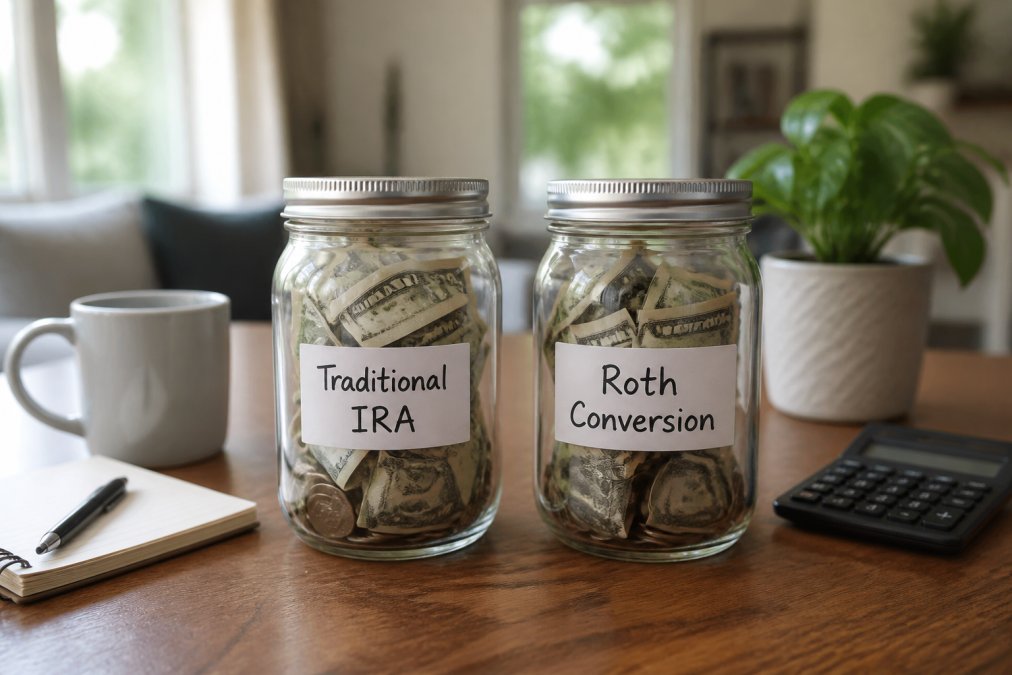
 comparison
Roth Conversion vs. Traditional IRA Withdrawal: 2026 Guide
Table of Contents
- What Is a Roth Conversion and How Does It Differ From a Traditional IRA Withdrawal?
- Tax Implications of Roth Conversion vs. Traditional IRA Withdrawal
- Traditional IRA Withdrawal Rules and Required Minimum Distributions
- When to Do a Roth Conversion: Timing and Scenario Analysis
- Roth Conversion Ladder Strategy and Long-Term Planning
- Roth Conversion vs. Taxable Brokerage Account: Which Approach Wins?
- Pros and Cons: Roth Conversion Versus Traditional IRA Withdrawal
- Common Mistakes and How Professional Guidance Prevents Costly Errors
Last Updated: July 30, 2026
What Is a Roth Conversion and How Does It Differ From a Traditional IRA Withdrawal?
A Roth conversion moves money from a pre-tax retirement account (like a Traditional IRA or 401(k)) into a Roth IRA, where you pay income taxes upfront but enjoy tax-free growth and withdrawals thereafter. A Traditional IRA withdrawal simply removes funds from your pre-tax account, triggering immediate income tax on the withdrawn amount while leaving remaining balances subject to future taxation.
When you execute a Roth conversion, you're trading current tax liability for permanent tax-free status on that money. A Traditional IRA withdrawal treats the distribution as ordinary income in the year you take it, the money leaves the account and enters your taxable income calculation.
Tax Implications of Roth Conversion vs. Traditional IRA Withdrawal
When you convert $100,000 from a Traditional IRA to a Roth, that full amount gets added to your taxable income for the year. In the 24% federal tax bracket, you owe approximately $24,000 in federal taxes, due in April of the following year. A Traditional IRA withdrawal of the same amount also triggers $24,000 in federal taxes at that bracket level. The difference: with a withdrawal, you're done. With a conversion, you've paid taxes on money that stays invested in a tax-free account for potentially decades.
The pro-rata rule complicates Roth conversions when you hold multiple pre-tax retirement accounts. This IRS rule treats ALL your pre-tax IRAs as one pool for tax calculation purposes. If you own a $400,000 Traditional IRA and a $100,000 SEP IRA, converting $50,000 means only $10,000 of that conversion comes from after-tax contributions. The remaining $40,000 is taxable. Many people overlook this rule and face unexpected tax bills.
State-Specific Tax Implications for South Carolina Residents
South Carolina does not tax retirement income for residents age 59½ and older, according to South Carolina Department of Revenue guidance. This creates a powerful incentive for Roth conversions during early retirement years (ages 59½-62) before Social Security and Required Minimum Distributions kick in.
However, the state does tax ordinary income for all residents, including conversion income. A South Carolina resident in the 24% federal bracket pays approximately 7% state income tax on conversion amounts, bringing the combined tax hit to roughly 31% before age 59½. Once you reach 59½, that state tax disappears on qualified distributions, making conversions executed after that threshold substantially cheaper.
This creates a planning window many South Carolina residents miss: converting between ages 55-59½ costs more in state taxes, but waiting until 59½ allows penalty-free withdrawals from 401(k)s and IRAs. Tax-Free Me helps clients in Upstate South Carolina time conversions to minimize this state tax burden while maximizing long-term tax-free growth.
Traditional IRA Withdrawal Rules and Required Minimum Distributions
You can withdraw any amount from a Traditional IRA at any time after age 59½ without penalty. Before age 59½, you face a 10% early withdrawal penalty plus income tax on the full amount; exceptions exist for certain hardships but are narrow.
Required Minimum Distributions force the issue at age 73 (as of 2026, per the SECURE Act 2.0). The IRS requires you to withdraw a calculated percentage of your Traditional IRA balance each year, beginning April 1 after the year you turn 73. Miss the deadline or withdraw too little, and the penalty is 25% of the shortfall amount (reduced to 10% if corrected timely).
RMD Timelines and Penalty Avoidance
The RMD calculation uses your IRA balance on December 31 of the prior year divided by a life expectancy factor published by the IRS. A 73-year-old with a $400,000 IRA balance uses a divisor of approximately 26.5, resulting in an RMD of roughly $15,094. This amount must be withdrawn by December 31 of the year you turn 73.
Many people miss the first RMD deadline because it comes by April 1 of the year AFTER they turn 73, not by April 1 of the year they turn 73. If you turn 73 in 2026, your first RMD is due by April 1, 2027. Confusing the timeline costs thousands in penalties.
Roth conversions eliminate future RMDs entirely. Once money sits in a Roth IRA, no RMD applies during your lifetime. This is why many retirees with substantial Traditional IRA balances convert strategically in their 60s to reduce the RMD burden starting at 73.
How RMDs Impact Medicare Premiums and Other Benefits
RMDs increase your Modified Adjusted Gross Income (MAGI), which directly affects Medicare Part B and Part D premiums through Income-Related Monthly Adjustment Amounts (IRMAA). For 2026, a single filer with MAGI between $97,000 and $121,000 pays standard Part B premiums. Above $121,000, premiums jump significantly, sometimes an additional $100-$200 per month per person.
A $500,000 Traditional IRA might force RMDs of $18,000-$20,000 annually starting at age 73. For a married couple with modest other income, this RMD alone could push them above IRMAA thresholds, increasing their Medicare costs by $2,400-$4,800 per year. Over a 20-year retirement, that's $48,000-$96,000 in additional Medicare costs.
Roth conversions executed before age 73 prevent this scenario. By converting $150,000-$200,000 annually in years 60-72, you reduce your Traditional IRA balance and future RMDs, protecting Medicare premiums in your mid-70s.
When to Do a Roth Conversion: Timing and Scenario Analysis
The optimal timing for a Roth conversion depends on three factors: your current tax bracket, your expected future tax bracket, and your ability to pay conversion taxes from non-IRA sources. Most people should consider conversions between ages 55-62, after leaving the workforce but before Social Security and RMDs begin.
Partial Conversions for Tax Bracket Management
Partial conversions let you stay within your current tax bracket while repositioning assets. Suppose you're a 62-year-old married couple with $40,000 in Social Security income and $30,000 in pension income, total MAGI of $70,000. Your standard deduction is $29,200, leaving $40,800 of taxable income. You're in the 12% federal tax bracket with room to add $20,000 more income before jumping to 22%.
Converting exactly $20,000 keeps you in the 12% bracket and costs roughly $2,400 in federal taxes (plus South Carolina state tax if applicable). You can repeat this strategy for three to five years, converting $15,000-$25,000 annually. Over five years, you've converted $100,000 at an average tax cost of roughly 15%, far cheaper than taking a lump-sum withdrawal.
Pre-Retirees vs. Retirees: Different Conversion Windows
Pre-retirees (ages 55-62 still working) face a different calculus than retirees. If you're earning $150,000 annually, converting $50,000 pushes your MAGI to $200,000, potentially triggering IRMAA surcharges and higher ACA premiums. For pre-retirees, conversions make sense only if you can afford the tax hit without disrupting your current cash flow.
Retirees aged 65+ with Social Security and pensions already flowing have more predictable income. They can see exactly how much conversion capacity they have before triggering tax bracket jumps or Medicare surcharges. The window closes at 73 when RMDs begin.
Roth Conversion Ladder Strategy and Long-Term Planning
A Roth conversion ladder is a multi-year strategy where you convert Traditional IRA funds to Roth in a series, each conversion subject to the five-year rule. A 55-year-old with a $500,000 Traditional IRA can execute a five-year conversion ladder, converting $100,000 annually. After five years, the first $100,000 sits in a Roth ready for withdrawal without penalties.
This is particularly useful for people retiring before 59½ who want to bridge the gap until 59½ or 62 when penalty-free withdrawals become available.
The 5-Year Rule and Early Access Without Penalties
The five-year rule states that converted funds must remain in the Roth for five calendar years before withdrawal without penalty. The clock starts January 1 of the year of conversion. A conversion executed on December 15, 2026, counts as a 2026 conversion; the five-year period ends December 31, 2030. You can withdraw that $50,000 on January 1, 2031, with no 10% early withdrawal penalty.
Earnings on converted funds have their own five-year rule. If your $50,000 conversion grows to $60,000, you can withdraw the $50,000 principal penalty-free after five years. The $10,000 in earnings remains subject to the 10% penalty if you're under 59½, plus income tax.
Roth Conversion vs. Taxable Brokerage Account: Which Approach Wins?
If you convert $100,000 and pay $24,000 in taxes, you have $76,000 in Roth IRA growing tax-free. Over 20 years at 6% annual growth, that Roth $76,000 becomes $244,000. In a taxable account, $76,000 becomes approximately $200,000 after accounting for 15% long-term capital gains tax annually. The Roth wins by $44,000.

Tax-Free Growth and Withdrawal Advantages
Roth accounts offer tax-free growth and tax-free withdrawals. A taxable brokerage account offers neither. A $100,000 Roth IRA earning 6% annually for 25 years becomes $429,000, all tax-free. The same $100,000 in a taxable account earning 6% but paying 20% in annual taxes on gains becomes approximately $270,000 after taxes. The Roth generates $159,000 more wealth over 25 years.
Estate Planning and Beneficiary Considerations
Traditional IRAs come with a tax bill for your heirs. When your child inherits a $500,000 Traditional IRA, they must take distributions and pay income tax on every dollar. A Roth IRA passes tax-free to heirs. Your child inherits $500,000 and takes distributions with no income tax liability. For high-net-worth individuals in Upstate South Carolina concerned about legacy benefits, converting to Roth in your 60s means your heirs receive substantially more wealth.
Pros and Cons: Roth Conversion Versus Traditional IRA Withdrawal
Roth Conversion Pros:
- Eliminates future RMDs, protecting Medicare premiums and reducing lifetime tax liability
- Creates tax-free growth for 20-30+ years in retirement
- Provides tax-free withdrawals with no income limits or age restrictions
- Passes tax-free wealth to heirs
- Allows strategic execution across multiple years to manage tax brackets
- Enables Roth conversion ladder strategy for early retirement access
Roth Conversion Cons:
- Requires paying taxes upfront from non-IRA sources
- Increases MAGI in conversion year, potentially triggering IRMAA surcharges and ACA premium increases
- Subject to pro-rata rule if you hold multiple pre-tax IRAs
- Locks you into a tax rate you can't change
Traditional IRA Withdrawal Pros:
- No upfront tax payment required beyond the withdrawal amount
- Maintains flexibility to leave money invested in tax-deferred accounts
- No pro-rata rule complications
- Allows deferral of taxes until you actually need the money
Traditional IRA Withdrawal Cons:
- Creates mandatory RMDs starting at age 73, forcing withdrawals even if you don't need the money
- RMDs increase MAGI, triggering IRMAA surcharges and higher Medicare costs
- Leaves heirs with a tax bill on inherited distributions
- Continues annual tax drag if you reinvest withdrawals in taxable accounts
- Misses opportunity for decades of tax-free growth
When Each Strategy Makes Sense for Your Situation
Roth conversions make sense if you're between ages 55-72 with predictable income below your tax bracket ceiling, have substantial assets outside your IRA to pay conversion taxes, expect to live 20+ years in retirement, want to minimize Medicare surcharges and RMDs, or care about leaving tax-free wealth to heirs.
Traditional IRA withdrawals make sense if you need money immediately and can't afford conversion taxes, are over 80 with limited life expectancy, have minimal liquid assets outside your IRA, face an unusually high tax bracket in the current year, or expect tax rates to fall significantly in the future.
For most retirees in Upstate South Carolina aged 60-72, a hybrid approach works best: execute partial Roth conversions during years 60-72 to manage tax brackets, then switch to Traditional IRA withdrawals after age 73 when RMDs force withdrawals anyway.
Common Mistakes and How Professional Guidance Prevents Costly Errors
The most expensive mistake is executing a large Roth conversion without understanding the pro-rata rule. A 65-year-old with a $1 million Traditional IRA and $200,000 in a SEP IRA decides to convert $100,000. They calculate federal tax as roughly $24,000. But the pro-rata rule treats all pre-tax IRAs as one pool: $100,000 × ($200,000 / $1.2 million) = $16,667 is considered after-tax contributions. The remaining $83,333 is taxable at 24%, meaning actual federal tax is $20,000, not $24,000, a $4,000 underestimation.
Another common mistake: converting in a year when you also claim Social Security, triggering unexpected IRMAA surcharges. A 67-year-old converts $50,000 and claims Social Security simultaneously. Their MAGI jumps to $85,000, pushing them into an IRMAA bracket that increases Medicare Part B premiums by $150-$200 monthly. Over five years, that's $9,000-$12,000 in additional Medicare costs.
A third mistake: executing conversions without considering the five-year rule. A 58-year-old converts $100,000 expecting to withdraw it in two years for a home purchase. The five-year rule prevents penalty-free withdrawal. They face a 10% penalty plus income tax on the $100,000, negating the conversion benefit entirely.
Tax-Free Me helps clients avoid these mistakes by modeling conversions before execution. We calculate pro-rata impact, project IRMAA consequences, and ensure five-year rule compliance. For residents of Upstate South Carolina, this coordination is particularly important because state tax implications vary based on age and income.
Deciding between a Roth conversion versus Traditional IRA withdrawal isn't a one-time decision, it's a multi-year strategy that requires coordination with Social Security, Medicare, and estate planning goals. The difference between executing this strategy correctly and making costly mistakes can easily exceed $50,000-$100,000 over your lifetime.
Tax-Free Me specializes in exactly this kind of comprehensive planning. With 25 years of experience from financial advisor R. Neal Angel, the firm helps clients in Upstate South Carolina navigate tax-efficient retirement income strategies, optimize Social Security benefits, and implement tax-free income approaches that reduce lifetime tax liability. Rather than making isolated decisions about individual withdrawals, Tax-Free Me coordinates your entire retirement picture to maximize after-tax wealth and legacy benefits. If you're within 10 years of retirement or already retired, a consultation with Tax-Free Me can clarify whether Roth conversions, traditional withdrawals, or a hybrid strategy makes sense for your situation.
| Strategy | Best Age Range | Tax Cost | RMD Impact | Heir Benefit |
|---|---|---|---|---|
| Roth Conversion | 55-72 | Immediate (24-31%) | Eliminates RMDs | Tax-free inheritance |
| Traditional IRA Withdrawal | 59½+ | Deferred (taxed at withdrawal) | Forces RMDs at 73 | Heirs pay income tax |
| Conversion Ladder | 55-62 | Spread over 5+ years | Reduces future RMDs | Tax-free access after 5 years |
| Taxable Brokerage (no conversion) | Any age | Annual tax drag on gains | N/A | Step-up in basis at death |
According to IRS guidance on Roth conversions and pro-rata rules, understanding the pro-rata rule is essential before executing any conversion from a Traditional IRA when you hold multiple pre-tax retirement accounts. Research from the National Institute on Retirement Security indicates that retirees who coordinate Roth conversions with Social Security timing reduce lifetime taxes by an average of 15-20% compared to those who make isolated withdrawal decisions. Additionally, the SECURE Act 2.0 changes to RMD rules have shifted the optimal timing window for conversions, making current professional guidance more valuable than strategies based on pre-2023 law.
Frequently Asked Questions
What is the main difference between a Roth conversion and a traditional IRA withdrawal?
A Roth conversion moves pre-tax money from a traditional IRA into a Roth IRA, triggering immediate income tax on the converted amount but allowing tax-free growth and withdrawals thereafter. A traditional IRA withdrawal simply takes money out, subject to income tax at your ordinary rate. The key distinction: conversion creates a new tax-deferred-to-tax-free account; withdrawal is a one-time distribution. Conversions require paying taxes now to avoid them later; withdrawals defer the tax question until you actually need the funds.
How does a Roth conversion affect my Medicare premiums and other benefits?
Roth conversions increase your Modified Adjusted Gross Income (MAGI) in the year of conversion, which can trigger higher Medicare premiums (IRMAA surcharges) and affect other income-sensitive benefits. For example, a large conversion might push you into a higher IRMAA bracket, increasing Part B and Part D costs. Some benefits, like Supplemental Security Income, may also be affected. This is why partial conversions over multiple years are often recommended, spreading the tax liability reduces the risk of a single year's spike pushing you into a higher benefit bracket.
What is the 5-year rule for Roth conversions, and why does it matter?
The 5-year rule requires that converted funds sit in a Roth IRA for five tax years before you can withdraw the converted amount penalty-free before age 59½. This is separate from the 5-year rule for earnings. If you convert at age 58, you cannot withdraw the converted principal without penalty until age 63 (five years later). This rule is critical for those using a Roth conversion ladder strategy to access funds early in retirement. Understanding this timeline prevents unexpected penalties and helps you plan liquidity around your actual retirement date.
Can I do a partial Roth conversion to manage my tax bracket, and how does that work?
Yes. A partial conversion allows you to convert only a portion of your traditional IRA in a given year, spreading the tax liability across multiple years. For example, if converting $100,000 would push you into a higher tax bracket, you might convert $30,000 per year for three years instead. This strategy helps you stay in a lower bracket, minimize IRMAA impact, and avoid unexpected tax surprises. Tools like the Charles Schwab or Fidelity Roth conversion calculators can model partial conversions to show you the tax impact of different scenarios.
How does a Roth conversion ladder help me access retirement funds before age 59½?
A Roth conversion ladder involves converting portions of a traditional IRA to a Roth IRA over several years, then withdrawing the converted (not earned) amounts after the 5-year holding period expires. Because converted amounts are treated as contributions, they can be withdrawn penalty-free after five years, even before age 59½. This creates a 'ladder' of annual conversions, each with its own 5-year clock, allowing systematic access to retirement funds during early retirement years without the 10% early withdrawal penalty.
This article was written using GrandRanker