 ultimate-guide
Social Security Optimization for Married Couples: A 2026 Guide
Table of Contents
- Understanding Social Security Optimization for Married Couples
- Filing Strategies for Married Couples: Core Approaches
- Social Security Survivor Benefits Rules for Married Couples
- Social Security Break-Even Analysis for Couples
- Health Status and Life Expectancy: Personalizing Your Decision
- Medicare Enrollment and Social Security Optimization Timing
- Working While Receiving Benefits and the Earnings Test
- Inflation, COLA, and Long-Term Income Security for Couples
Social Security Optimization for Married Couples: A 2026 Guide
Last Updated: July 15, 2026
When married couples approach retirement, they face one of the most consequential financial decisions of their lives. According to the Social Security Administration, the average married couple can increase their lifetime benefits by $50,000 or more through strategic claiming decisions. This guide covers social security optimization for married couples, a coordinated strategy that considers both spouses' ages, health, work history, and household income needs. Claiming at the wrong time can cost a couple hundreds of thousands of dollars in lifetime benefits.
Understanding Social Security Optimization for Married Couples
Why Married Couples Need a Coordinated Strategy
Married couples have access to benefit types that singles do not: spousal benefits, survivor benefits, and family maximums. A decision that looks optimal for one spouse in isolation may actually reduce the household's total lifetime income.
The Social Security Administration allows married couples to claim spousal benefits equal to up to 50% of the higher-earning spouse's Primary Insurance Amount (PIA), provided the lower-earning spouse has reached Full Retirement Age. This benefit does not reduce the higher earner's payment. If one spouse passes away, the surviving spouse becomes eligible for widow or widower benefits based on the deceased spouse's earnings record, often higher than their own benefit.
These rules create a planning opportunity many couples overlook. A couple where one spouse has significantly higher lifetime earnings might benefit from the lower-earning spouse claiming early while the higher earner delays. The lower earner receives their own reduced benefit plus, eventually, a spousal benefit boost. Meanwhile, the higher earner's benefit grows by 8% per year until age 70, maximizing the survivor benefit protection for the lower-earning spouse.
The Role of Full Retirement Age and Delayed Retirement Credits
Your Full Retirement Age (FRA) is the age at which you become eligible for your full Primary Insurance Amount. For most people retiring in 2026, FRA falls between 66 and 67 depending on birth year.
Delayed retirement credits increase your monthly benefit by 8% for each year you wait past FRA, up to age 70. For a couple, this creates a fundamental tension: one spouse should often claim early or at FRA to access spousal benefits and survivor protections, while the other delays to maximize their own benefit and the survivor benefit available to their spouse.
Suppose the higher-earning spouse has a PIA of $2,400 per month. At FRA (age 67), they receive $2,400. If they wait until age 70, they receive $2,400 × 1.24 = $2,976. The lower-earning spouse with a PIA of $1,200 can claim their own benefit at 62 ($840/month, reduced by 30%), or wait until FRA to receive $1,200. If they wait until FRA while the higher earner delays to 70, the lower earner becomes eligible for a spousal benefit of $1,200 (50% of the higher earner's PIA), which exceeds their own reduced benefit.
Filing Strategies for Married Couples: Core Approaches
Synchronized vs. Staggered Filing Timelines
Synchronized filing means both spouses claim at roughly the same time, typically at Full Retirement Age. This approach simplifies decision-making and works best for couples with similar life expectancies and earnings records. The disadvantage is that neither spouse maximizes delayed retirement credits, and the household forgoes the survivor benefit protection that comes from one spouse delaying to 70.
Staggered filing means one spouse claims early (often at 62) while the other delays past FRA, ideally to 70. This approach maximizes lifetime household income for couples where one spouse has significantly higher earnings. The lower-earning spouse claims early, receives their reduced benefit, and later becomes eligible for a spousal benefit as the higher earner's benefit grows. Meanwhile, the higher earner's delayed benefit reaches its maximum, ensuring the surviving spouse receives the largest possible widow or widower benefit.
Spousal Benefits and Survivor Benefits Coordination
A spouse can receive up to 50% of the primary earner's PIA, but only if the spouse has reached Full Retirement Age. The spousal benefit does not increase if you delay past FRA. This means a lower-earning spouse who delays from age 67 to 70 gains nothing in spousal benefit, though their own benefit grows by 24%. This is why the lower-earning spouse should rarely delay claiming.
When a spouse passes away, the surviving spouse becomes eligible for a widow or widower benefit equal to the deceased spouse's Full Retirement Age benefit. This benefit does not depend on the survivor's own earnings record. A higher-earning spouse who delays to 70 instead of claiming at 67 increases their benefit by 24% and also increases the survivor benefit by 24%, providing significant protection for the lower-earning spouse.
Social Security Survivor Benefits Rules for Married Couples
Widow or Widower Benefits and Family Protections
When a married person passes away, their surviving spouse becomes eligible for widow or widower benefits. These benefits are not means-tested and do not depend on the survivor's own earnings record. A surviving spouse at Full Retirement Age receives 100% of what the deceased spouse was receiving. A surviving spouse who claims before FRA receives a reduced benefit. A surviving spouse can claim as early as age 50 if disabled, or age 60 if not disabled.
The Social Security Administration also protects minor and disabled children. If the deceased spouse had children under age 19 (or 19 if still in high school), those children become eligible for benefits equal to 75% of the deceased parent's PIA. Families with young children should factor this protection into their claiming decision.
Family maximums apply to survivor benefits. The total amount paid to a family cannot exceed 150% to 180% of the deceased worker's PIA. This means if the deceased spouse had a high PIA and multiple survivors, each survivor's benefit may be reduced proportionally.
Social Security Break-Even Analysis for Couples
Calculating Your Break-Even Point by Age and Life Expectancy
A break-even analysis compares the total lifetime benefits received under different claiming strategies. For example, a higher-earning spouse with a PIA of $2,400 who can claim at age 67 ($2,400/month) or wait until age 70 ($2,976/month) faces a difference of $576 per month. By waiting three years, they forgo $86,400 in benefits. To break even, they must live long enough for the larger monthly benefit to make up this gap: $86,400 ÷ $576 = 150 months, or 12.5 years past age 70, which is age 82.5.
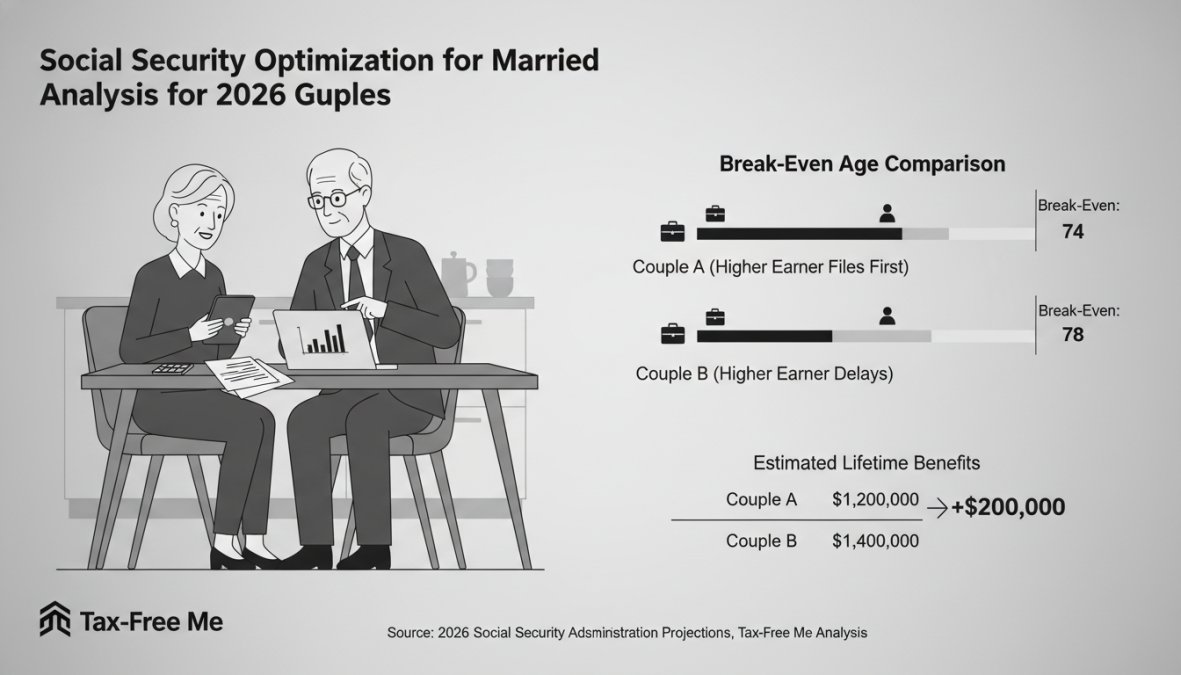
This analysis becomes more complex for couples because survivor benefits change the calculus. A widow or widower benefit based on a higher earner's delayed claim is permanently larger than one based on an earlier claim. Even if the higher earner passes away before the break-even age, their spouse receives a larger survivor benefit for the rest of their life.
| Claiming Age | Monthly Benefit | Age 80 Total | Age 85 Total | Age 90 Total |
|---|---|---|---|---|
| 67 (FRA) | $2,400 | $345,600 | $518,400 | $691,200 |
| 70 | $2,976 | $357,120 | $565,440 | $773,760 |
When Early Claiming Makes Sense vs. Delayed Retirement
Early claiming (at 62) is appropriate if a spouse has significant health concerns or family history of early mortality. Additionally, couples with limited savings may need the income immediately, even if it reduces lifetime benefits.
For the lower-earning spouse in a staggered filing strategy, early claiming often makes sense. The lower earner receives their reduced benefit immediately, plus a spousal boost at FRA, which together may exceed what they'd receive by waiting.
Delayed claiming (to 70) is appropriate for higher-earning spouses with good health and family longevity. The 24% increase in benefits, combined with the permanent increase in survivor benefits, justifies the three-year wait for most couples.
Health Status and Life Expectancy: Personalizing Your Decision
Health status and family longevity patterns are the most important inputs to a claiming decision. A spouse with a serious illness that reduces life expectancy should claim early, even if break-even analysis suggests delay. Conversely, a spouse with excellent health and family history of longevity should delay.
Many couples focus only on their own health and ignore their spouse's health. But survivor benefits mean that the healthier spouse's claiming decision has outsized importance. A higher-earning spouse in excellent health should delay to 70 even if the lower-earning spouse has health concerns. The lower earner can claim early to access income, while the higher earner's delayed benefit ensures the surviving spouse has adequate income in old age.
Over a 30-year retirement, the compounding effect of Cost-of-Living Adjustments (COLA) on a higher benefit becomes substantial. A benefit claimed at 62 is locked in permanently at that reduced level. A benefit claimed at 70 is 24% higher and grows with COLA each year.
Medicare Enrollment and Social Security Optimization Timing
Coordinating Medicare Part B Enrollment with Benefit Claims
Medicare eligibility begins at age 65, regardless of when you claim Social Security. If you claim Social Security before age 65, you must still enroll in Medicare Part B at age 65 or face late enrollment penalties. These penalties are permanent and add 10% to your Part B premium for each year you delay enrollment after age 65.
If you claim Social Security at age 65 or later, you are automatically enrolled in Medicare Part A and Part B.
A critical consideration for married couples is the impact of Social Security income on Medicare premiums. Medicare Part B and Part D premiums are means-tested based on Modified Adjusted Gross Income (MAGI). Higher Social Security income increases MAGI, which triggers higher Medicare premiums. For couples with substantial non-Social Security income, delaying Social Security claiming can reduce Medicare premiums. The lower household income in the interim years results in lower Medicare premiums when Social Security finally begins.
Working While Receiving Benefits and the Earnings Test
Before reaching Full Retirement Age, Social Security imposes an earnings test. For every $2 earned above the annual limit (approximately $23,400 in 2026), $1 is withheld from your benefit.
This earnings test applies only to the person working, not to their spouse. If the lower-earning spouse claims at 62 and continues working, their benefit is reduced by the earnings test. However, years of continued work increase their Primary Insurance Amount, which increases their future spousal benefit.
Once you reach Full Retirement Age, the earnings test no longer applies. You can earn unlimited income without losing benefits. This is another reason why the lower-earning spouse should claim at 62 and continue working if desired.
Inflation, COLA, and Long-Term Income Security for Couples
Cost-of-Living Adjustments (COLA) protect Social Security benefits from inflation. Each year, benefits are increased by the percentage change in the Consumer Price Index. COLA compounds on the benefit amount at the time of claim. A benefit claimed at 70 grows with COLA from age 70 onward. A benefit claimed at 62 grows with COLA from age 62 onward, but from a smaller base.
Over a 30-year retirement, this compounding effect is substantial. A $2,400 benefit at age 62, growing at 2.5% annually, becomes roughly $5,100 by age 92. A $2,976 benefit at age 70 (24% higher), growing at 2.5% annually, becomes roughly $6,300 by age 92. The delay to 70 not only increases the base benefit but also results in a significantly higher benefit in old age, when healthcare costs and long-term care needs are greatest.
Bringing It All Together: A Decision Framework
Here's a practical framework to guide your decision:
Step 1: Identify the higher earner. The spouse with the larger Primary Insurance Amount should almost always be the one to delay claiming.
Step 2: Assess health and longevity. Does the higher earner have good health and family history of longevity? If yes, delay to 70. Does the lower earner have health concerns? If yes, claim early.
Step 3: Evaluate household income needs. Do you need income immediately, or can you wait? Couples with sufficient savings can afford to wait.
Step 4: Calculate the break-even point. Use the Social Security Administration's benefit calculator to estimate your break-even age under different claiming scenarios.
Step 5: Consider survivor benefits. Even if the higher earner doesn't live to break-even, the surviving spouse receives a larger benefit for life.
Step 6: Account for Medicare and taxes. Higher Social Security income affects Medicare premiums and tax liability.
The decision about when to claim Social Security is one of the most important financial choices you'll make in retirement. For married couples, the stakes are even higher because your decision affects not only your own income but also your spouse's survivor benefits and your household's tax liability. A strategic approach to social security optimization for married couples can increase your lifetime income substantially while protecting your spouse's financial security.
Frequently Asked Questions
How do spousal benefits work for married couples claiming Social Security?
Spousal benefits allow a spouse who earned less to claim up to 50% of the higher-earning spouse's Primary Insurance Amount at Full Retirement Age. The higher earner's benefit is unaffected. For couples, coordinating when each person claims, especially if one spouse delayed retirement credits, can significantly increase household lifetime benefits. A spouse may claim reduced spousal benefits as early as age 62, but the reduction is permanent.
What is the break-even point in social security break-even analysis for married couples?
The break-even point is the age at which the total lifetime benefits from delayed claiming equal the total from early claiming. For most married couples, this occurs in the early-to-mid 80s. If both spouses have good health and family longevity history, delaying benefits past Full Retirement Age, especially to age 70 for delayed retirement credits, often yields higher lifetime household income. A retirement planner can calculate your specific break-even age based on individual earnings records.
What happens to Social Security benefits when one spouse dies?
Under social security survivor benefits rules, the surviving spouse becomes eligible for widow or widower benefits, typically 75% of the deceased spouse's Primary Insurance Amount if claimed at Full Retirement Age, or reduced amounts if claimed earlier (as early as age 60, or age 50 if disabled). Dependent children under 19 (or 19 if in high school) and the surviving spouse caring for children under 16 also qualify. Survivor benefits do not reduce the deceased's lifetime earnings record used for the surviving spouse's own retirement benefit.
At what age should married couples start taking Social Security?
The optimal age depends on health, life expectancy, other income sources, and household coordination. Earliest eligibility begins at age 62, but benefits are permanently reduced. Full Retirement Age, ranging from 66 to 67 depending on birth year, provides unreduced benefits. Delayed retirement credits increase benefits 8% annually until age 70. For couples where one spouse has significantly higher lifetime earnings, delaying that spouse's claim while the lower earner claims earlier often maximizes household benefits. A financial advisor specializing in retirement planning can model your specific scenario.
How does the earnings test affect married couples who work while receiving Social Security?
Before reaching Full Retirement Age, the Social Security Administration reduces benefits $1 for every $2 earned above an annual threshold (adjusted yearly for inflation). After reaching Full Retirement Age, there is no earnings test, you can work and receive full benefits. For married couples, the earnings test applies individually to each spouse's benefit, so one spouse's continued work does not reduce the other's benefits. This is relevant for couples where one spouse retires early and the other continues working.
Can married couples use a spousal benefit strategy if both have high lifetime earnings?
Yes, but the strategy differs. If both spouses have substantial lifetime earnings, each receives their own Primary Insurance Amount plus any applicable spousal benefit (the difference between 50% of the spouse's PIA and their own PIA). Filing strategies for married couples with similar high earnings often focus on coordinated claiming ages, for example, one spouse delaying to 70 for maximum delayed retirement credits while the other claims at Full Retirement Age, to optimize household lifetime benefits and survivor protection.
How does Medicare enrollment timing affect Social Security optimization for married couples?
Medicare eligibility begins at age 65, independent of Social Security claiming. However, delaying Social Security past 65 while enrolling in Medicare Part B (and paying premiums) affects household cash flow and tax planning. For couples, coordinating Medicare Part B enrollment with Social Security filing can reduce taxable income and optimize tax-advantaged strategies. A tax-focused retirement planner can help align these timelines to minimize overall tax burden while maximizing benefit coordination.
This article was written using GrandRanker