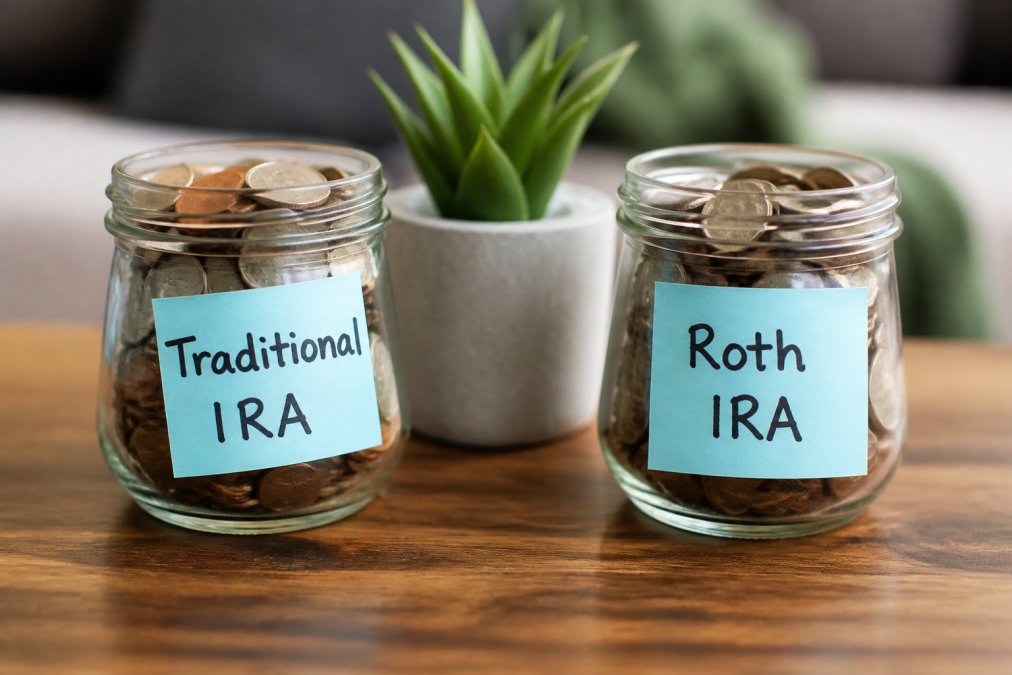
 comparison
Traditional IRA vs. Roth for 2026 Retirees
Table of Contents
- Traditional IRA vs. Roth IRA: Side-by-Side Comparison
- Key Differences Between Roth and Traditional IRAs
- 2026 IRA Contribution Limits and Catch-Up Rules
- Tax Treatment: Tax-Deferred Growth vs. Tax-Free Withdrawals
- Required Minimum Distributions (RMD) Rules and Planning
- Roth Conversion Tax Implications for 2026 Retirees
- Which Account Type Wins for Your Retirement?
- Conclusion
Last Updated: August 15, 2026
Traditional IRA vs. Roth IRA: Side-by-Side Comparison
The choice between a traditional IRA and a Roth IRA fundamentally shapes your retirement tax burden. For retirees in 2026, this decision directly determines how much you'll owe in taxes over the next 20 to 30 years. According to IRS guidance on retirement account taxation, the tax treatment of these accounts differs so dramatically that choosing the wrong one can cost tens of thousands of dollars in lifetime tax liability.
A traditional IRA offers an upfront tax deduction on contributions, reducing your taxable income today. A Roth IRA provides no immediate deduction, you contribute after-tax dollars, but all growth and qualified withdrawals come out completely tax-free in retirement. This distinction matters most for retirees because Required Minimum Distributions (RMDs) from traditional accounts can push you into higher tax brackets, while Roth accounts have no RMDs during your lifetime.
For 2026 retirees, the real question is which account minimizes your lifetime tax liability given your current income, expected withdrawals, and legacy goals. The answer depends on whether you expect to be in a higher or lower tax bracket in retirement than you are today.
| Feature | Traditional IRA | Roth IRA | Winner for 2026 Retirees |
|---|---|---|---|
| Upfront Tax Deduction | Yes, reduces current taxable income | No deduction | Traditional (if in high bracket now) |
| Tax-Free Growth | Tax-deferred only | Fully tax-free | Roth |
| Qualified Withdrawals | Fully taxable as income | Completely tax-free | Roth |
| Required Minimum Distributions | Start at age 73 | None during lifetime | Roth |
| Income Phase-Out | No limit (but deduction phases out) | Strict income limits | Traditional (higher earners) |
| Roth Conversion | Possible (taxable event) | N/A | , |
| Best For | Those expecting lower retirement tax bracket | Those expecting higher or stable bracket | Depends on your bracket trajectory |
The real decision hinges on tax bracket modeling. If you're currently in the 24% federal bracket and expect to drop to 12% in retirement, a traditional IRA's upfront deduction saves you more than a Roth's tax-free growth. If you're in the 24% bracket now and expect to stay there or climb higher, Roth wins. For high-asset individuals, the interaction with Medicare IRMAA (Income-Related Monthly Adjustment Amount) and state taxes often tips the scales toward Roth conversions.

Key Differences Between Roth and Traditional IRAs
The fundamental difference is timing: when you pay taxes and whether your money grows tax-free or tax-deferred. A traditional IRA is tax-deferred, contributions may be deductible from your current taxable income, but withdrawals in retirement are taxed as ordinary income. A Roth IRA is tax-free, you pay taxes on contributions upfront, but all qualified withdrawals, including decades of growth, come out completely tax-free.
For retirees, this distinction creates three major practical differences. First, traditional IRA withdrawals count as taxable income, which can trigger Medicare IRMAA surcharges and push you into higher tax brackets. Roth withdrawals don't count as income for these purposes. Second, traditional IRAs require Required Minimum Distributions starting at age 73, whether you need the money or not. Roth IRAs have no RMDs during your lifetime, allowing your money to grow untouched. Third, Roth heirs inherit tax-free assets, while traditional IRA beneficiaries inherit a tax liability.
The income phase-out rules differ sharply. Traditional IRAs have no income limit, though deductibility phases out for high earners covered by workplace retirement plans. Roth IRAs have strict income phase-outs: in 2026, single filers phase out between $146,000 and $161,000 (modified adjusted gross income). Married couples filing jointly phase out between $230,000 and $240,000. This is why high-income earners often use the "backdoor Roth" strategy, contributing to a traditional IRA and immediately converting it to a Roth to bypass income limits.
For someone with $500,000 in a Roth IRA that grows to $1.2 million by age 80, that $700,000 in gains is entirely tax-free. The same growth in a traditional IRA would trigger substantial tax liability on withdrawal.
2026 IRA Contribution Limits and Catch-Up Rules
You can contribute up to $7,000 annually to either a traditional or Roth IRA in 2026. Once you turn 50, you can contribute an additional $1,000 per year, bringing your total to $8,000 annually. This catch-up provision is one of the few remaining tax-advantaged opportunities available to older workers and retirees still earning income.
The contribution deadline is April 15, 2027, giving you flexibility if you receive year-end income. You must have earned income to contribute to an IRA. For married couples where one spouse has no earned income, the spousal IRA rule allows the working spouse to contribute on behalf of the non-working spouse, up to the same limits.
Tax Treatment: Tax-Deferred Growth vs. Tax-Free Withdrawals
In a traditional IRA, contributions may be tax-deductible in the year you make them. This upfront deduction reduces your taxable income dollar-for-dollar. If you contribute $8,000 and you're in the 24% federal tax bracket, you save $1,920 in federal taxes that year. The money grows tax-deferred, but every dollar you withdraw in retirement is taxed as ordinary income.
In a Roth IRA, contributions are never deductible, but all growth is completely tax-free, and qualified withdrawals are never taxed. If you contribute $8,000 and that grows to $50,000 over 20 years, you withdraw the full $50,000 tax-free.
The after-tax comparison reveals why Roth often wins for retirees. Suppose you're in the 24% bracket now and expect to be in the 22% bracket in retirement. A $1,000 traditional IRA contribution saves you $240 in taxes today, but when you withdraw that $1,000 in retirement, you owe $220 in taxes. By contrast, a $1,000 Roth contribution costs you $240 in taxes today, but when you withdraw it plus $2,000 in gains (total $3,000), you owe nothing.
Withdrawals from traditional IRAs count as income for Medicare IRMAA calculations. A $50,000 traditional IRA withdrawal could trigger IRMAA surcharges that increase your Medicare Part B and Part D premiums by thousands of dollars. The same $50,000 Roth withdrawal doesn't count as income.

Required Minimum Distributions (RMD) Rules and Planning
Starting in 2026, the RMD age is 73 for traditional IRAs. You must begin taking distributions no later than April 1 of the year following the year you turn 73. After that, distributions must be taken by December 31 each year.
The RMD calculation divides your traditional IRA balance as of December 31 of the prior year by a life expectancy factor provided by the IRS. If you're 73 with a $500,000 traditional IRA, your life expectancy factor is approximately 26.5, so your RMD is roughly $18,868. You must withdraw at least this amount or face a 25% penalty on the shortfall.
The critical issue is that RMDs are forced taxable income. Even if you don't need the money, you must withdraw it, and it counts as ordinary income. If you take a $50,000 RMD and you're already receiving $30,000 in Social Security benefits, your combined income is $80,000, pushing you into a higher tax bracket and triggering taxation on 85% of your Social Security benefits.
Roth IRAs have no RMD requirement during your lifetime. Your money can continue growing tax-free indefinitely, and you only withdraw what you need. For those with large traditional IRAs, Roth conversions can reduce the balance subject to RMDs and create tax-free income sources in retirement.
Roth Conversion Tax Implications for 2026 Retirees
A Roth conversion means moving money from a traditional IRA into a Roth IRA. You pay income taxes on the amount converted in that year, but the converted amount then grows tax-free forever. For 2026 retirees, the conversion itself creates a taxable event that can trigger Medicare IRMAA surcharges, Social Security taxation, and higher state income taxes.
If you convert $100,000 from a traditional IRA to a Roth IRA and you're in the 24% federal bracket, you owe $24,000 in federal taxes. But the real cost includes more: a large conversion can push your Modified Adjusted Gross Income (MAGI) over Medicare IRMAA thresholds, triggering surcharges on Medicare Part B and Part D premiums. A $100,000 conversion might cost you $24,000 in federal taxes plus $3,000-$5,000 in additional Medicare premiums.
The strategic approach involves "laddering" conversions over multiple years. Instead of converting $100,000 in a single year, convert $30,000 annually over three years. This spreads the income impact, potentially avoiding IRMAA thresholds and keeping Social Security taxation lower.
For 2026 specifically, many provisions of the 2017 Tax Cuts and Jobs Act expire after 2025, meaning tax brackets are scheduled to revert to pre-2017 levels. This creates a unique planning window: converting to a Roth while current tax rates are still in effect locks in lower tax costs compared to future rates.
Which Account Type Wins for Your Retirement?
The answer depends entirely on your tax bracket today versus your expected tax bracket in retirement, your legacy goals, and your interaction with Medicare and Social Security.
Choose a traditional IRA if: You're in a high tax bracket now (32% or higher) and expect to be in a lower bracket in retirement. You have substantial earned income this year and want immediate tax relief. You're not eligible for Roth contributions due to income phase-outs. You want to reduce your taxable income today to avoid IRMAA surcharges or Social Security taxation.
Choose a Roth IRA if: You expect your retirement tax bracket to be similar to or higher than your current bracket. You want to eliminate future RMD complications and maintain flexibility in retirement. You plan to leave assets to heirs and want them to inherit tax-free money. You're under age 59½ and want access to contributions without penalty. You want to diversify your retirement income between tax-deferred and tax-free sources.
Consider Roth conversions if: You have a large traditional IRA and want to reduce future RMDs. You're in a low-income year. You have the cash to pay conversion taxes outside your retirement accounts. You want to create tax-free income sources for years when you expect higher expenses.
For most 2026 retirees, the optimal strategy is tax diversification. Maintain both traditional and Roth accounts so you have flexibility to manage your tax bracket year to year. In years when you're in a low bracket, take Roth conversions. In years when you need income, draw from traditional accounts if your bracket is already high, or Roth if you want to keep your taxable income low.
Securing your retirement requires more than choosing between account types, it demands a comprehensive tax strategy that accounts for Medicare premiums, Social Security optimization, and legacy planning. At Tax-Free Me, we specialize in helping retirees like you model these decisions across your complete financial picture. Led by 25-year veteran financial advisor R. Neal Angel, our team focuses on implementing tax-advantaged income strategies and Roth conversions that minimize your lifetime tax liability while maximizing what you leave to your heirs. If you're concerned about how RMDs will affect your taxes or whether a Roth conversion makes sense for your situation, we can help you run the numbers and build a plan that actually works.
Frequently Asked Questions
What are the 2026 IRA contribution limits for retirees age 50 and older?
Retirees age 50 and older can make catch-up contributions to both Traditional and Roth IRAs. Check the IRS website for exact 2026 limits, as these amounts adjust annually for inflation. Catch-up contributions allow you to save additional funds beyond the standard limit, which is especially valuable when you're nearing retirement and want to maximize tax-advantaged savings.
How do Required Minimum Distributions (RMD) rules differ between Traditional and Roth IRAs?
Traditional IRAs require you to begin taking Required Minimum Distributions at a specific age, with distributions treated as taxable income. Roth IRAs have no RMD requirement during your lifetime, allowing tax-free growth to continue. This difference makes Roth accounts attractive for retirees who don't need immediate income and want to minimize taxable income that could affect Medicare premiums or Social Security taxation.
Is a Roth conversion worth doing if I'm retiring in 2026?
Whether a Roth conversion makes sense depends on your current tax bracket, expected retirement tax bracket, and how conversion income affects Medicare premiums and Social Security taxation. Converting during a lower-income year, such as the year you retire but before RMDs begin, can be advantageous. However, converting too much in one year may push you into a higher tax bracket or trigger Medicare surcharges. A personalized analysis of your complete financial picture is essential before proceeding.
How does my tax bracket influence the choice between Traditional and Roth IRAs?
If you expect to be in a higher tax bracket in retirement than you are now, a Roth IRA's tax-free withdrawals provide greater value. If you expect to be in a lower bracket in retirement, a Traditional IRA's upfront tax deduction may be more beneficial. Your effective tax rate and marginal tax rate both matter, especially when considering how withdrawals interact with Social Security taxation and Medicare income-related premiums.
Can I still contribute to a Roth IRA after I retire in 2026?
You can contribute to a Roth IRA as long as you have earned income, regardless of age. If you have no earned income in retirement, you cannot make new Roth contributions. However, you can still execute a Roth conversion of existing Traditional IRA or 401(k) funds, which does not require earned income and may be a valuable strategy for retirees seeking tax diversification and tax-free legacy benefits.
This article was written using GrandRanker