 ultimate-guide
Retirement Tax Planning for Heirs: A 2026 Guide
Table of Contents
- Why Retirement Tax Planning for Heirs Matters
- Understanding Required Minimum Distributions and Their Impact on Heirs
- The SECURE Act 10-Year Rule and Non-Spouse Beneficiaries
- Roth IRA Conversion as a Tax-Free Legacy Strategy
- Step-Up in Basis: Maximizing Tax Efficiency for Inherited Assets
- Naming Beneficiaries: Spouse vs. Non-Spouse Considerations
- Trust Structures and Retirement Account Inheritance
- State-Specific Tax Considerations for South Carolina Residents
Last Updated: August 3, 2026
Retirement tax planning for heirs is one of the most overlooked aspects of estate preparation, yet it directly determines how much wealth actually transfers to your family. When you die, your retirement accounts trigger a cascade of income tax liabilities that can consume 30-40% or more of what you've spent decades building. Below, we'll show you exactly how to structure your retirement accounts now so your heirs inherit wealth, not tax headaches.
Why Retirement Tax Planning for Heirs Matters
Your retirement accounts are tax-deferred vehicles by design. Every dollar in a traditional IRA or 401(k) is money the IRS has essentially loaned you at a future date. When you pass those accounts to your heirs, that future date arrives immediately, and the tax bill lands on them.
A $500,000 traditional IRA inherited by an adult child doesn't mean your child receives $500,000. Depending on their tax bracket and distribution timeline, they might net only $300,000 after federal income taxes, Medicare surcharges, and state taxes. Strategic moves made today, Roth conversions, beneficiary naming choices, and trust structures, can reduce or eliminate those taxes entirely. The difference between a plan and no plan often exceeds six figures for families with substantial retirement savings.

Understanding Required Minimum Distributions and Their Impact on Heirs
Required Minimum Distributions (RMDs) are mandatory annual withdrawals from tax-deferred retirement accounts once you reach age 73 (as of 2026). The amount is calculated by dividing your account balance by a life expectancy factor published by the IRS. For someone with a $500,000 IRA at age 73, the first-year RMD might be around $18,000.
Here's the critical piece for heirs: any RMD you don't take during your lifetime becomes your beneficiary's responsibility. If you die with an outstanding RMD, your heirs inherit both the account and the income tax liability for that withdrawal, forcing them into higher tax brackets and triggering Medicare surcharge thresholds.
How RMDs Affect Your Estate Value
When you have substantial retirement savings, RMDs can force withdrawals that exceed your living expenses. You withdraw $25,000 annually to satisfy the RMD, but you only need $15,000 to live. That extra $10,000 gets taxed and typically goes into taxable investment accounts, where it generates additional taxes through capital gains. Over a 15-year retirement, that forced excess withdrawal scenario can transfer $150,000 or more into taxable accounts, reducing the amount available for your heirs.
Planning RMDs to Reduce Tax Burden on Heirs
The most effective RMD strategy is to convert portions of your traditional IRA to a Roth IRA while you're in a lower tax bracket. If you're 62 and still earning income, you might be in the 22% federal tax bracket. You can convert $50,000 from your traditional IRA to a Roth, paying $11,000 in taxes today. That $50,000 grows tax-free in the Roth and passes to your heirs completely tax-free. When RMDs begin at 73, your traditional IRA balance is smaller, so the mandatory withdrawal is smaller, and your heirs inherit less taxable income.
The years between leaving your job and claiming Social Security offer a 3-5 year window where conversion makes exceptional sense.
The SECURE Act 10-Year Rule and Non-Spouse Beneficiaries
The Setting Every Community Up for Retirement Enhancement (SECURE) Act, which took effect in 2020, fundamentally changed how non-spouse beneficiaries inherit retirement accounts. The old "stretch IRA" strategy no longer exists for most inheritors.
Under the 10-year rule, non-spouse beneficiaries must fully distribute an inherited IRA within 10 years of the account owner's death. Beneficiaries can take distributions whenever they choose during those 10 years, as long as the account is empty by December 31 of the 10th year following death. This rule applies to adult children, grandchildren, nieces, nephews, and friends. Spouses retain special privileges and can still treat an inherited IRA as their own or stretch distributions.
What the 10-Year Distribution Rule Means for Your Heirs
The 10-year rule creates a bunching problem. Your child inherits a $300,000 IRA and has 10 years to empty it. If they wait until year 9 and realize they haven't taken enough, they might face a $100,000 distribution in year 10, which pushes them into a much higher tax bracket than planned.
If you convert portions of your traditional IRA to Roth before you die, you reduce the size of the taxable account your heirs inherit. A $300,000 traditional IRA with a $100,000 Roth conversion means your heirs inherit only $200,000 in taxable assets instead of $300,000, and the Roth portion passes completely tax-free.
Tax Implications of the 10-Year Rule
The 10-year rule doesn't eliminate income tax; it changes the timeline and creates concentration risk. An inherited traditional IRA is still income-taxable when distributed. Your child withdraws $30,000 from the inherited IRA, and that $30,000 is taxed as ordinary income on their tax return that year.
For high-income beneficiaries earning $150,000+ annually, inherited IRA distributions can trigger Medicare surcharges, push them into higher tax brackets, or create unexpected Alternative Minimum Tax (AMT) liability. This is why Roth conversions during your lifetime are so powerful. Every dollar you convert to Roth is a dollar your heirs don't have to distribute and pay tax on.
Roth IRA Conversion as a Tax-Free Legacy Strategy
A Roth IRA conversion is the single most powerful tool for retirement tax planning for heirs. You convert money from a traditional IRA to a Roth IRA, pay income tax on the conversion amount today, and then that money grows tax-free forever and passes to heirs completely tax-free.
The optimal conversion window is typically between age 62 and age 73, after you stop working but before RMDs begin. During this period, your earned income is zero, so your taxable income is lower than during your working years.
Here's a concrete example: You retire at 62 with a $600,000 traditional IRA. Your Social Security doesn't start until 67. From age 62 to 67, you could convert $50,000 annually from your traditional IRA to a Roth IRA, paying tax on that $50,000 at your current marginal rate (likely 22% federally, or about $11,000 in taxes). Over five years, you've converted $250,000 to Roth and paid roughly $55,000 in taxes. Your heirs now inherit $250,000 in Roth (tax-free) and $350,000 in traditional IRA, saving them significant taxes on the inherited portion.
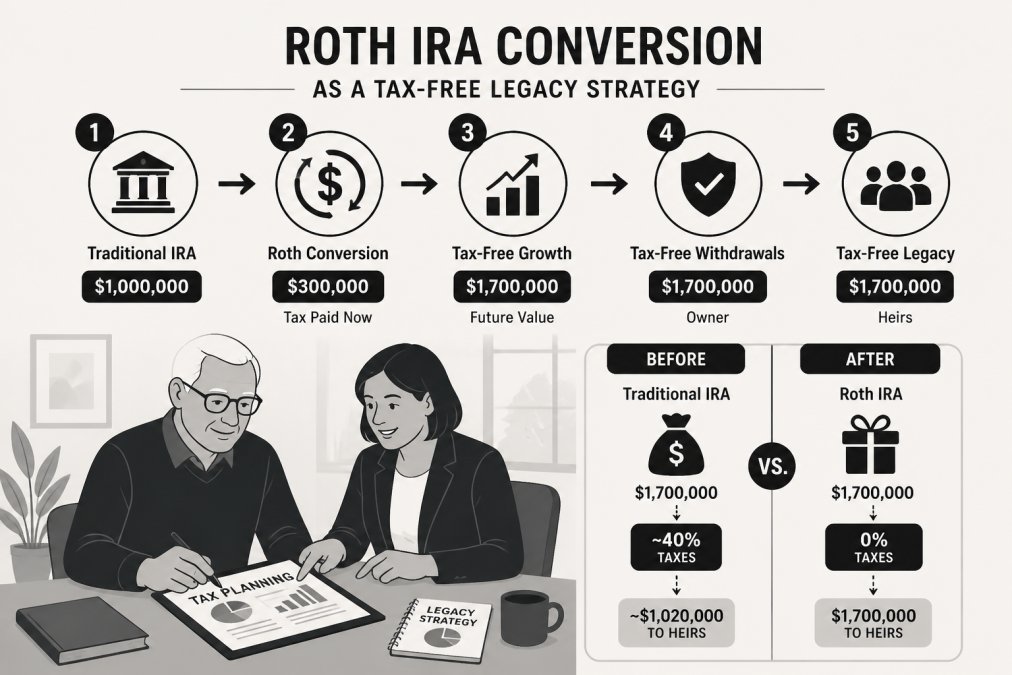
Tax Bracket Planning and Conversion Timing
The success of a Roth conversion strategy depends entirely on timing. You want to convert in years when you're in the lowest possible tax bracket, not years when you're forced to take large distributions or have unexpected income.
South Carolina residents have an advantage: the state has no income tax on retirement income. A Roth conversion in South Carolina is taxed only at the federal level, not state level. If you're considering moving to South Carolina in retirement, the timing of that move relative to conversions matters significantly.
Step-Up in Basis: Maximizing Tax Efficiency for Inherited Assets
Step-up in basis is a tax rule that resets the cost basis of inherited assets to their market value on the date of death. This applies only to non-retirement assets.
You buy 100 shares of Microsoft at $100/share in 2010 (cost basis: $10,000). By 2026, those shares are worth $400,000. Normally, if you sold them, you'd owe capital gains tax on the $390,000 gain. But if you hold the shares until you die, your heirs inherit them with a "stepped-up" basis of $400,000. If they sell immediately, there's zero capital gains tax.
A $500,000 traditional IRA does NOT get step-up in basis. Your heirs inherit it with a basis of $500,000 in ordinary income tax liability. But a $500,000 taxable investment account DOES get step-up in basis, and your heirs can inherit it tax-free.
How Step-Up Works for Non-Retirement vs. Retirement Accounts
Retirement accounts are income-tax-deferred, not capital-gains-deferred. The IRS views an inherited traditional IRA as a stream of ordinary income, not an asset with a cost basis. Non-retirement accounts are held in after-tax dollars, and the step-up in basis rule recognizes that you've already paid tax on the principal.
This creates a powerful planning opportunity: convert traditional IRA money to Roth (paying tax now) and let the taxable account step up in basis (paying zero tax at death). Example: You have $300,000 in a traditional IRA and $300,000 in a taxable brokerage account (cost basis $100,000, current value $300,000). If you convert $150,000 from the traditional IRA to Roth (paying $33,000 in taxes today), you reduce the taxable IRA to $150,000. Your heirs now inherit $150,000 in taxable income (roughly $45,000 in taxes over 10 years) and $300,000 in stepped-up assets (zero taxes). You paid $33,000 in taxes to save your heirs $45,000, a net family savings of $12,000.
Naming Beneficiaries: Spouse vs. Non-Spouse Considerations
Beneficiary designation is the single most important document you'll create for retirement tax planning for heirs. It overrides your will and determines exactly who inherits your accounts and under what rules.
Spouses and non-spouses are treated completely differently under tax law. A surviving spouse can treat an inherited IRA as their own, roll it into their own IRA, and defer distributions until their own RMD age. A non-spouse beneficiary must begin distributions within 10 years under the SECURE Act.
Spousal Rollover Options and Tax Deferral
When a spouse inherits a traditional IRA, they can elect to treat it as their own IRA. This is called a spousal rollover, and it's the most tax-efficient option for most married couples. The surviving spouse's RMDs don't begin until they reach age 73, potentially deferring distributions by 5-10 years or more.
This deferral is powerful because it allows the inherited account to continue growing tax-deferred. If a 65-year-old widow inherits a $400,000 IRA, she can treat it as her own IRA, allow it to grow until she's 73, and potentially have $550,000+ at that point. She's had 8 years of tax-free growth on inherited money.
Non-Spouse Beneficiary Tax Planning
Adult children and other non-spouse beneficiaries face the 10-year distribution rule. They must empty the inherited account by December 31 of the 10th year following the account owner's death. The 10-year rule allows flexibility in distribution timing, but most beneficiaries don't plan ahead and discover in year 9 that they need to empty the account, facing a large, concentrated distribution that creates a tax spike.
The solution is to plan distributions in advance and reduce the size of the inherited taxable account through Roth conversions during your lifetime. Every dollar you convert to Roth is a dollar your child doesn't have to distribute and pay tax on.
Trust Structures and Retirement Account Inheritance
Naming a trust as beneficiary of a retirement account is a common estate planning strategy, but it creates significant tax complications. When you name a trust as the beneficiary of an IRA, the trust becomes the "designated beneficiary" for purposes of the 10-year rule. The trust must distribute the entire inherited IRA within 10 years of your death.
However, trusts don't get the same tax treatment as individuals. A trust reaches the top federal tax bracket (37%) at around $14,000 of taxable income (as of 2026). An individual doesn't reach the top bracket until around $700,000 of taxable income. This means if the trust receives a large distribution from an inherited IRA, that distribution is taxed at the highest rate almost immediately.
How Trusts Affect Distribution Timelines and Tax Liability
If the trustee takes all $300,000 in year 5, the trust owes federal income tax on $300,000 at trust rates, roughly $111,000 in federal taxes (37% top rate). If instead the trust could distribute the $300,000 directly to the trust beneficiaries, those distributions would be taxed on their individual returns at their individual rates, potentially saving $20,000-$40,000 in taxes.
The solution is to use a "conduit trust" or "accumulation trust" structure that allows the trustee to pass distributions through to beneficiaries, preserving their individual tax brackets. A conduit trust requires the trustee to distribute all IRA distributions to the trust beneficiaries immediately. An accumulation trust allows the trustee to hold distributions in the trust if needed, but this creates higher tax costs.
| Trust Type | Distribution Timeline | Tax Treatment | Best For |
|---|---|---|---|
| Conduit Trust | All distributions pass through immediately to beneficiaries | Beneficiary's tax bracket | Maximizing tax efficiency |
| Accumulation Trust | Trustee can hold distributions in trust | Trust's higher tax bracket | Control and creditor protection |
| No Trust (Direct Beneficiary) | 10-year rule for non-spouses | Individual beneficiary's tax bracket | Simplicity and tax efficiency |
State-Specific Tax Considerations for South Carolina Residents
South Carolina offers significant tax advantages for retirement planning. The state has no income tax on retirement income, which means Social Security benefits are not taxed, and retirement account distributions are taxed only at the federal level.
This is a major advantage compared to states like New York, California, or Massachusetts, which tax retirement income heavily. For a South Carolina resident with a $500,000 IRA, the lack of state income tax saves roughly 5-7% on inherited distributions compared to a high-tax state.
South Carolina does not have a separate state estate tax, so the only estate tax concern is federal. A resident of Upstate South Carolina with $800,000 in retirement savings can structure Roth conversions, Social Security claiming, and beneficiary designations to minimize income tax in ways that residents of high-tax states cannot.
If you have adult children who live in high-tax states, the tax efficiency of distributions is even more important, as they'll pay both federal and state income tax on inherited IRA distributions. This argues for even more aggressive Roth conversion strategies during your lifetime.
Building a Retirement Tax Plan That Protects Your Heirs
Retirement tax planning for heirs isn't a single decision, it's a series of coordinated choices made over years, starting ideally 5-10 years before retirement. Start by gathering your account statements: How much do you have in traditional IRAs, 401(k)s, and Roth IRAs? What's the cost basis in taxable brokerage accounts? When will you turn 73 and face RMDs? When will you claim Social Security?
Next, run projections. Model what your tax bracket will be each year from now until you die. Model what your heirs' tax brackets will be when they inherit. Model different Roth conversion scenarios: what if you convert $50,000 per year? What if you convert $100,000?
Then, test different beneficiary designation strategies and execute the plan. This might mean doing a Roth conversion in 2026 when you have lower income, delaying Social Security to age 70 to reduce your RMD burden, or adjusting your beneficiary designations to optimize for your heirs' tax situations.
Working with a financial advisor who specializes in retirement tax planning is one of the best investments you can make. The difference between a thoughtful plan and no plan often exceeds six figures for families with substantial retirement savings.
At Tax-Free Me, we help South Carolina residents build comprehensive retirement tax plans that protect their heirs. Our approach focuses on understanding your complete financial picture, retirement accounts, taxable investments, Social Security timing, and your heirs' situations, and then structuring a plan that minimizes lifetime and inherited taxes. We specialize in Roth conversions, RMD optimization, and legacy planning strategies that ensure your heirs inherit wealth, not tax bills.
Retirement tax planning for heirs is one of the most important decisions you'll make, yet it's often left to chance. The strategies we've covered, Roth conversions, RMD planning, beneficiary optimization, and trust structures, can save your family hundreds of thousands of dollars in taxes. The time to start is now, not when you're already retired or when your heirs are managing your accounts. Work with a financial advisor who understands both the technical complexity of retirement accounts and the specific tax landscape in South Carolina, and ensure your legacy is protected for the next generation.
Frequently Asked Questions
What is the SECURE Act 10-year rule and how does it affect my heirs?
The SECURE Act 10-year rule requires most non-spouse beneficiaries to fully distribute inherited retirement accounts within 10 years of the account owner's death. This accelerates the distribution timeline compared to the old stretch IRA rules, which means your heirs must withdraw and pay income taxes on the funds more quickly. The compressed timeline can push beneficiaries into higher tax brackets. Planning ahead with Roth conversions or strategic distributions before death can help minimize the tax impact on your heirs' inherited accounts.
How does a Roth IRA conversion reduce taxes for my heirs?
Converting a traditional IRA to a Roth IRA during your lifetime shifts the tax burden to you now, when you control your tax bracket, rather than forcing your heirs to pay taxes on distributions later. Roth IRAs grow tax-free and qualified withdrawals are tax-exempt, meaning your heirs inherit an account with no required distributions and no income tax liability on the growth. This strategy works best when you expect your heirs to be in higher tax brackets or when you have other income sources to cover conversion taxes without depleting the account itself.
What is the step-up in basis and does it apply to inherited retirement accounts?
The step-up in basis allows heirs to inherit non-retirement assets at their fair market value on the date of death, not the original purchase price. This eliminates capital gains taxes on appreciation that occurred during the original owner's lifetime. However, step-up in basis does not apply to inherited retirement accounts like IRAs or 401(k)s, which retain their tax-deferred status. Your heirs still owe income taxes on distributions from these accounts. This is why converting some traditional retirement funds to Roth accounts before death can be valuable: Roth accounts are not subject to income tax on distributions, making them more valuable to pass to heirs.
Should I name my spouse or my adult children as beneficiaries of my retirement accounts?
Spousal beneficiaries have more flexibility: they can do a spousal rollover and treat the inherited account as their own, deferring taxes and required distributions. Non-spouse beneficiaries like adult children face the 10-year rule and must pay income taxes on all distributions within that window. Naming a spouse makes sense if they depend on the income and will need ongoing access. For high-net-worth estates where you want to pass wealth tax-efficiently, naming a trust or considering Roth conversions before death may protect your children from a large tax bill. Your specific situation depends on your spouse's financial needs, your children's tax brackets, and your overall estate value.
How can I minimize the tax burden my heirs will face when they inherit my retirement accounts?
Start with strategic Roth conversions now, paying taxes at your current rate to create tax-free assets for your heirs. Plan your Required Minimum Distributions to manage your tax bracket and avoid pushing yourself into a higher bracket that forces larger withdrawals. Consider naming the right beneficiaries (spouse vs. non-spouse) based on your family's needs. Review your trust structure with a tax professional to ensure it does not inadvertently trigger additional taxes. Finally, model different scenarios: what happens if your heirs inherit in different years, at different ages, or in different tax situations. Working with a financial advisor experienced in retirement tax planning can help you build a strategy tailored to your family's circumstances.
This article was written using GrandRanker